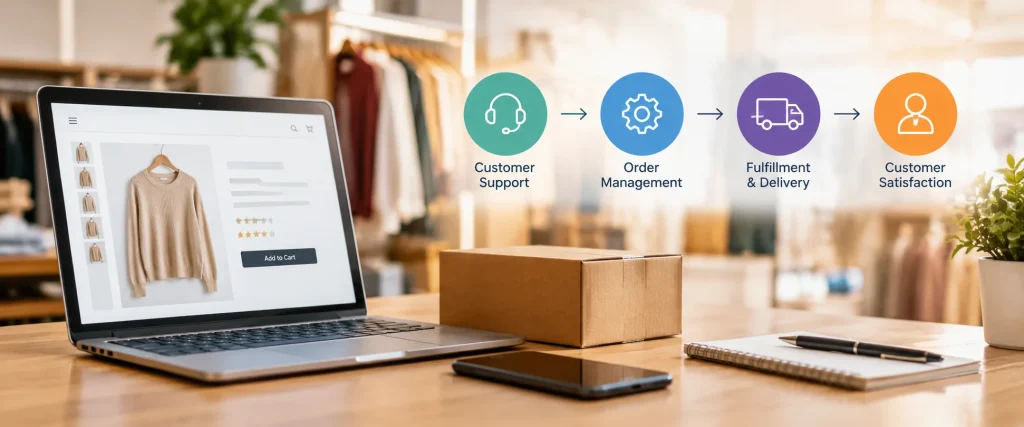







U.S. ecommerce growth can look healthy on a sales dashboard while creating a very different picture inside customer service. More orders bring more delivery questions, returns, payment issues, product questions, and exceptions that need human judgment. For growing brands, scaling ecommerce customer service starts with understanding what is driving contact volume, not simply adding seats.
The market is still expanding. The U.S. Census Bureau reported $340.2 billion in seasonally adjusted retail ecommerce sales for the second quarter of 2026. That was 12.2% higher than a year earlier, and ecommerce represented 17.1% of total retail sales. Growth also puts more pressure on the systems that support orders after checkout.
That pressure matters when customers are careful about where they spend. As we explored, customer interactions change when U.S. shoppers become more selective; service quality can influence repeat business.
More Orders Do Not Create Customer Contacts at the Same Rate
A simple forecast might assume that a 20% increase in orders requires 20% more customer service capacity. Ecommerce operations rarely behave that neatly. A better starting point is the relationship between orders and contacts.
Projected customer contacts = projected orders × expected contacts per order
Historical contacts per order provide a useful baseline. Teams may also track contact rate, or the share of orders that trigger support. Promotions can bring more first-time buyers, while carrier delays create WISMO contacts. Complex products can generate setup questions, and expectation gaps can increase returns.
U.S. ecommerce brands need to know which orders, channels, and products create the most support demand. They should also watch whether repeat contacts are pushing workload higher.
Where Does Support Pressure Usually Appear First?
Post-purchase questions are often an early sign that ecommerce customer support is under strain. Customers want to know whether an order shipped, why tracking stopped moving, or when it will arrive. At scale, these questions can consume significant capacity.
WISMO is a clear example. Better proactive communication and accurate order visibility can prevent some contacts before they enter the queue. Our guide to reducing WISMO before it consumes support capacity looks more closely at that problem. Strong order management and tracking support can also help teams resolve delivery questions with fewer handoffs.
Returns create another layer of work. More orders can mean more exchanges, refund questions, damaged-item reports, and reverse-logistics exceptions. That makes returns, refunds, and claims processing part of the capacity conversation. Pre-purchase questions and payment problems can add pressure at the same time.
How Do You Know Customer Service Is Falling Behind Growth?
The clearest warning is a pattern in which volume grows while response speed, resolution quality, or customer effort steadily worsens. Leaders should look at several operating signals together rather than waiting for complaints to be the first indicator.
- Response times: Are customers waiting longer across voice, chat, and email?
- Backlog: Are yesterday’s contacts still open when today’s volume arrives?
- Repeat contacts: Are customers coming back because the first interaction did not solve the issue?
- Contact rate: Is the number of contacts per order rising?
- Quality: Are faster handling targets hurting first contact resolution or customer satisfaction?
The trend matters more than any single number. Our guide to the customer-support KPIs that reveal operational strain covers measures that connect performance with accessibility, cost, and customer outcomes.
Fix Avoidable Demand Before Adding More Agents
Some support pressure comes from genuine growth. Some comes from processes that create unnecessary contacts. Treating both as a staffing shortage can increase cost without making service easier for customers.
High WISMO may point to weak shipment visibility. Repeated product questions may reveal gaps in product content or the knowledge base. Frequent order corrections can signal a checkout or data issue. Repeat contacts may show that agents lack the access or authority needed to resolve problems the first time.
Removing avoidable demand should be part of scaling ecommerce customer service. Automation and self-service can handle predictable questions, while human support remains important for exceptions, judgment, emotion, and work that crosses several systems.

Five Ways Ecommerce Brands Can Add Customer Service Capacity
Once avoidable demand is reduced, the next question is how to add capacity without weakening quality. The right choice depends on demand predictability, channel mix, operating hours, complexity, and expected growth.
| Capacity Option | Best Fit | Watch For |
|---|---|---|
| Process improvement | Avoidable or repeat contacts | Will not absorb genuine growth alone |
| Automation and self-service | Repetitive, low-complexity questions | Exceptions still need escalation |
| Permanent hiring | Sustained, predictable growth | Recruiting, training, and fixed capacity |
| Seasonal or overflow staffing | Known peaks and temporary surges | Training and access require planning |
| Outsourced capacity | Growth, variable demand, longer hours, or new channels | Integration, governance, and quality control |
For some businesses, the best answer is a combination. An internal team can retain complex work while another team handles defined queues or peak volume. The decision should start with the work itself.
Our comparison of in-house versus outsourced support decisions can help teams evaluate those tradeoffs. The goal is to build scalable customer service operations that can flex without fragmenting the customer journey.
When Does External Ecommerce Support Make Sense?
Ecommerce customer service outsourcing becomes worth evaluating when demand grows faster than the internal team can recruit, train, and manage without losing consistency. It may also fit when the business needs longer hours, new channels, or seasonal capacity.
A company should first define which interactions belong with the internal team, which can be standardized, and which require access to order, payment, fulfillment, or returns systems. If the business decides to outsource ecommerce customer service, the external team needs enough context and authority to resolve the work it receives.
The same principle applies to ecommerce call center outsourcing and broader ecommerce support outsourcing. Extra headcount has limited value when agents cannot see order history, understand policies, complete a return, or escalate an exception correctly.
What Scaling Ecommerce Customer Service Looks Like in Practice
One ServeRetail engagement shows why capacity and quality have to grow together. A premium travel goods brand expanded customer support nearly fourfold while sustaining 92% quality performance. Processes, onboarding, coaching, and quality oversight had to keep pace.
The result is specific to that engagement, not a universal benchmark. The broader lesson is that growth becomes more sustainable when the operating model scales with the people. Read the full customer support scaling case study.
U.S.-Based, Nearshore, or Blended Capacity?
Delivery location should follow the requirements of the work. Some brands may need U.S.-based customer service capacity for specific programs or operating needs. Others may use nearshore or offshore teams for added coverage, multilingual support, or a blended model.
The comparison should go beyond location. Ecommerce leaders should evaluate training, system access, schedule coverage, data requirements, escalation paths, and interaction complexity. Lower staffing cost has little value if the model creates more transfers or unresolved contacts.
Plan the Ramp Before the Queue Forces the Decision
External capacity still requires preparation. Teams need workflow documentation, systems access, knowledge transfer, training, quality calibration, reporting rules, and a controlled path into production. The exact ramp depends on the scope and complexity of the program.
Capacity planning should therefore begin before service levels deteriorate. Our guide to what a realistic customer-service ramp requires explains the work between selecting a partner and reaching stable production.
For a growing U.S. ecommerce business, a practical plan answers three questions early: how much volume is coming, which demand can be prevented, and which work needs more people.
Scale the Operation, Not Just the Headcount
Scaling ecommerce customer service works best when growth planning connects orders, contact drivers, processes, technology, and workforce capacity. More agents may be part of the answer, but they should not be the only answer.
ServeRetail helps ecommerce organizations strengthen customer care, order management, post-purchase workflows, returns, omnichannel support, and flexible capacity. The goal is to give growing operations room to handle more demand without allowing service quality to slip.
That challenge shows up elsewhere too \u2014 see Ecommerce Chargeback Management Outsourcing: A 2026 Playbook for Retail Brands.
That challenge shows up elsewhere too \u2014 see Missed Calls, Missed Orders: Why U.S. Ecommerce Brands Need Support Before Peak Demand.
That challenge shows up elsewhere too \u2014 see Scaling Retail Customer Service in Canada Without Compromising Brand Experience.
If your order volume is growing faster than your current support model can comfortably absorb, it may be time to look at where additional capacity would make the biggest difference. Explore How to Scale Your Ecommerce Support
Frequently Asked Questions
How should an ecommerce company estimate customer service capacity?
Start with projected order volume and expected contact rate. Then adjust for channel mix, seasonality, product complexity, returns, and known contact drivers. Historical contacts per order can provide a useful baseline.
What usually causes ecommerce customer service volume to increase?
Common drivers include order growth, WISMO, delivery delays, promotions, returns, payment issues, product questions, and channel expansion. Repeat contacts can increase workload further.
When should a growing ecommerce brand consider outsourced customer support?
It is worth evaluating when hiring cannot keep pace, seasonal peaks create recurring strain, operating hours expand, or new channels need coverage. The decision should follow a review of workflows, systems, quality requirements, and escalation rules.
Can automation reduce the need for more ecommerce support agents?
It can reduce repetitive contacts and make simple information easier to access. People are still needed for exceptions, complex returns, sensitive issues, and situations that require judgment across several systems.