



Every retailer says it wants better retail CX. Most then buy a new chatbot, refresh the app, and wait for applause. Customers, however, rarely judge you by your homepage. They judge you on the day a package runs late and nobody can explain why.
That gap between promise and delivery defines retail customer experience in 2026. Forrester’s 2026 CX Index found that 26% of US and Canadian brands posted significant gains. However, 68% stayed flat. After two decades inside retail operations, our view is direct. Better CX in retail rarely starts with marketing, because it starts with operations.
What Is Retail CX, and Why Has the Definition Changed?
Retail CX, or retail customer experience, is the complete experience a shopper has with a retailer. It spans discovery, purchase, fulfillment, service, returns, and loyalty across every channel. For years, CX for retail meant store design, site speed, and friendly staff. Today, operational performance shapes most of what customers remember. Inventory accuracy, carrier handoffs, refund timing, and agent knowledge now matter as much as any storefront. In short, modern CX in retail is an operating model, not a design layer.
Why Retail Customer Experience Breaks Behind the Storefront
Customers never see your warehouse system, returns queue, or agent schedule. Yet they feel every one of them. A delayed inventory sync becomes a cancelled order, and a vague refund rule becomes a one-star review. Retail customer experience is simply operations wearing a friendly face.
Steve Jobs made a related point at Apple’s 1997 developer conference. His advice still applies: “You’ve got to start with the customer experience and work backwards to the technology.” Retailers can apply that logic to operations. Start where the customer feels pain, then trace it back to the process behind it. Often, stronger retail back-office support fixes more complaints than a redesign.
Post-Purchase CX Is Where Operations Become Customer Experience
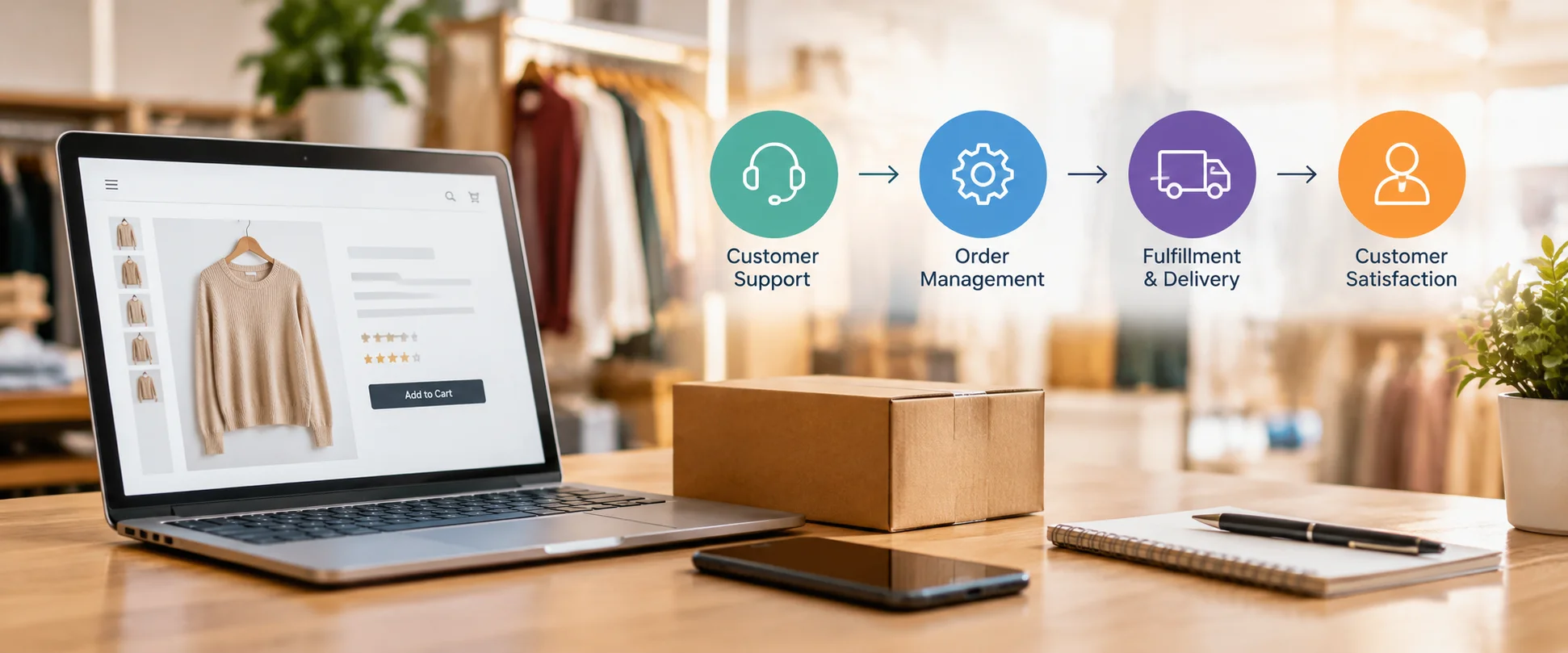
Most retail CX strategy budgets still pour into acquisition. Meanwhile, loyalty lives or dies after checkout. The post-purchase customer experience follows a predictable chain from purchase to fulfillment, tracking, delivery exceptions, returns, refunds, and support. That chain ends with one decision: whether the customer buys again. Every link is an operational process, and any link can break the relationship.
WISMO and Order Visibility
The “Where is my order?” call remains the most common symptom of a broken chain. Every WISMO contact signals an upstream communication gap. Proactive delay alerts and accurate carrier data answer the question before anyone dials. Dedicated order management and tracking support then lets agents resolve real exceptions instead of reading tracking pages aloud.
Returns, Refunds, and Claims
Returns carry even higher stakes. The NRF and Happy Returns estimate shoppers returned $849.9 billion in merchandise in 2025, or 15.8% of sales. NRF’s Katherine Cullen put it plainly: “Returns are no longer the end point of a transaction.” A disciplined returns, refunds, and claims workflow turns that cost into a reason to buy again.
Cost-to-Serve: The Retail CX Metric CX and Finance Should Share
Many brands track CSAT obsessively but never calculate cost-to-serve per order. As a result, they cannot see which experiences build profit and which quietly burn it. Cost-to-serve captures every dollar spent after the sale, including contacts, reships, refunds, and goodwill credits.
Cutting handle time looks great on a dashboard. However, a rushed agent who misses the root cause triggers a second and third contact. Cost-to-serve then rises while CSAT falls, which is an impressive way to lose twice. So should cost-to-serve sit beside CSAT on every executive scorecard? We believe it should, and our 2026 retail call center outsourcing pricing guide shows how these costs stack up.
Omnichannel Retail CX Requires One Operating Model
Shoppers do not think in channels. They browse on social media, buy in the app, pick up in store, and follow up by email. Omnichannel customer service fails when each channel runs separate rules, tools, and knowledge bases. Instead, one case history and one QA standard should follow the customer everywhere. BOPIS customer service exposes this gap faster than almost any other journey.
What Chewy Teaches About Scalable Personalization
Chewy shows how operations power delight. According to CCW Digital, the pet retailer began sending custom pet portraits in 2013. It later sent over 1,000 every week. Those gestures feel spontaneous, yet they rest on deliberate design. The formula combines context, agent authority, customer data, and fulfillment capability. Brands in pet supplies and beyond can borrow the principle without borrowing the paintbrush.
Why the Retail Contact Center Is Becoming a CX Operations Hub
The retail contact center sees every operational failure first. It hears about late carriers, confusing policies, and size charts that run small. Leading retailers mine contact data for root causes and route insights to merchandising and logistics. A good retail contact center tells you why customers call, not just how fast it answered.
Where AI Fits in an Operations-First Retail CX Strategy
AI earns its place when it removes operational friction, not when it automates a broken journey. First, AI can cluster thousands of conversations into clear contact-reason patterns. Next, AI-powered quality management can review every voice and chat interaction instead of a small sample. Agent assist and knowledge retrieval then speed up accurate answers. Routine order-status requests suit an AI voice agent. Exceptions, emotional moments, and high-value customers still belong with skilled humans.
Building an Operations-First Retail CX Transformation Roadmap
A practical retail CX transformation follows seven connected steps. Each one builds on the last.

1. Diagnose. Tag every interaction by contact reason for at least ninety days. This shows where friction actually lives.
2. Quantify. Connect each reason to cost-to-serve, repeat contacts, refunds, and churn risk. The ranking usually surprises leadership.
3. Fix upstream causes. Determine whether fulfillment, policy, inventory, or logistics creates each issue. Then assign an owner outside the contact center.
4. Orchestrate service. Connect workflows, data, and knowledge across every channel. Customers should never restart a conversation.
5. Automate selectively. Automate predictable interactions and escalate exceptions intelligently. Keep humans close to complex cases.
6. Measure outcomes. Track FCR, repeat-contact rate, resolution time, cost-to-serve, CSAT, and retention together. Retire metrics that reward speed over resolution.
7. Scale. Decide which capabilities stay internal and which benefit from specialist support. That decision leads naturally to outsourcing.
When Retail Customer Service Outsourcing Supports CX Transformation
Used well, retail customer service outsourcing strengthens operations instead of hiding problems. Retail contact center outsourcing adds elastic capacity, specialist talent, and sharper quality data without new infrastructure. That flexibility matters most before peak season, when missed calls quickly become missed orders. Retail depth matters too, which is why a retail-exclusive BPO handles returns and order exceptions better. Before signing, work through these 10 questions to ask any retail BPO.
What Operations-First Retail CX Looks Like in Practice
Consider one automotive parts ecommerce retailer under seasonal pressure. ServeRetail helped it build a more stable bilingual customer operation around real demand. As a result, the retailer held CSAT above 92% while improving conversion by more than 35%. When operations improve, service quality and revenue move together.
The Bottom Line: Retail CX Is an Operating Model, Not a Touchpoint
Retail CX transformation is not a rebrand, an app refresh, or a shiny chatbot. It is the patient work of fixing how orders move, returns flow, and customers get help. Therefore, your next step is not another campaign but an honest operational audit.
Turn Retail Operations Into a CX Advantage
ServeRetail is the BPO built exclusively for retail, from first click to final resolution. We help brands cut avoidable contacts, streamline returns, and scale retail customer service without losing the human touch. Book a free retail CX consultation with our team. Together, we will map where your operations cost you loyalty.


