
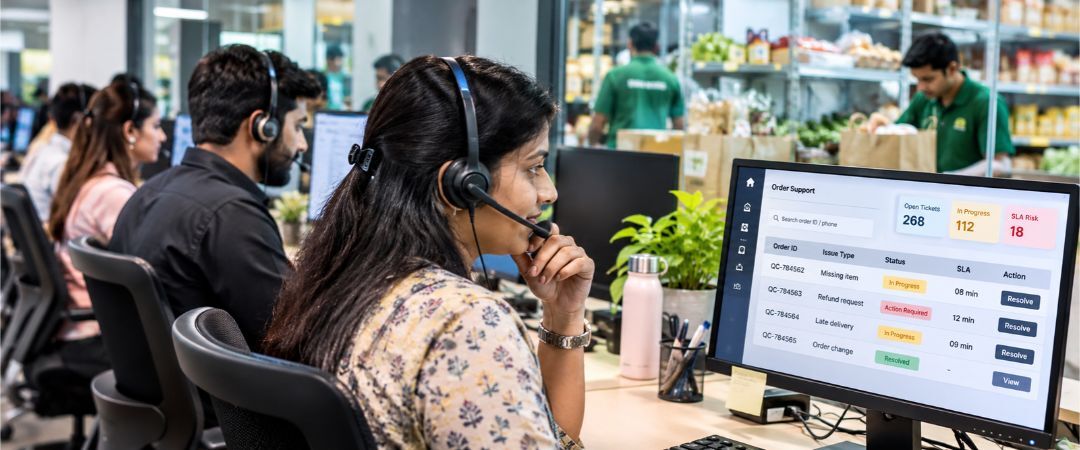

A quick-commerce customer reports a missing item from an order worth ₹650. Support verifies the complaint and says a refund has been initiated. The customer checks again later, cannot see the adjustment, and opens another chat. An agent transfers the case to a different queue. The next day, the customer follows up once more. The missing item caused the original complaint. The additional contacts came from the way the exception was handled.
For Indian instant-delivery operators, that distinction matters. A company may be processing more orders every month, yet spending more than necessary on repeat inquiries, manual refund follow-ups, and support escalations.
Quick commerce customer support outsourcing can help operators manage defined service workloads as volumes grow. But moving tickets to an external call center is useful only when the provider can resolve eligible cases accurately, work within approved policies, and prevent unnecessary repeat handling.
This guide explains how to assess the cost of quick-commerce customer support in India, which processes can be outsourced, what should remain under internal control, and how to evaluate whether an external support partner makes financial and operational sense.
Why Quick-Commerce Growth Changes the Customer Support Equation
India’s quick-commerce market has expanded beyond everyday groceries into personal care, household products, electronics, and other convenience purchases. More product categories and fulfillment locations can create different kinds of support inquiries, even when the customer sees a single ordering experience.
The scale is substantial. In its Q2 FY27 shareholder letter published on October 22, 2026, Swiggy reported that Instamart processed 130.3 million orders in the July–September quarter, up from 100.8 million a year earlier. The figures illustrate the volume large Indian quick-commerce operations handle; they do not establish what those companies spend on customer support.
Support requirements do not necessarily grow in direct proportion to orders. A well-designed self-service flow may prevent certain routine contacts. Better order information can reduce repeated status inquiries. Conversely, unclear refund processes or inconsistent escalation rules can generate additional work from a single incident.
For a Head of CX or Support Operations, the immediate challenge is to understand which contacts are necessary and which are caused by gaps in the current resolution process.
What Is Quick Commerce Customer Support Outsourcing?
Quick commerce customer support outsourcing means assigning defined customer service or remote support activities to an external provider under agreed service levels, system permissions, and operating rules.
For Indian quick-commerce businesses, the scope may include order inquiries, delivery complaints, missing-item claims, refund follow-ups, payment-related support, and selected back-office or operational coordination tasks.
The operator continues to own its policies, customer obligations, platform technology, and decisions reserved for internal teams. The BPO supplies trained representatives, supervision, reporting, and agreed service capacity for the outsourced work.
That distinction is particularly important in instant delivery. A customer service agent cannot correct a physical inventory discrepancy, dispatch a replacement rider, or change a restricted refund decision without the required authorization and systems. A suitable outsourcing model should therefore be designed around the work agents can actually complete, not merely the number of incoming tickets.
Why Support Cost per Order Matters More Than Agent Cost
When comparing an internal team with a quick commerce BPO, hourly agent cost is only one part of the decision. An operator also pays for supervision, training, workforce management, quality assurance, technology, recruitment, and the time spent reopening or transferring unresolved cases.
Two useful measures help explain the economics.
Customer support cost per order = Total customer support operating cost ÷ Total orders.

This shows the support burden across the ordering business. It is especially useful for following trends as volumes, product categories, and cities change.
Cost per resolved exception = Total exception-handling cost ÷ Exceptions resolved to the agreed standard.
This examines how efficiently the support function resolves actual problems. It should use a consistent definition of resolution, including how reopened cases are treated.
Neither measure is sufficient alone. A support team could appear inexpensive while customers experience repeated contacts, unresolved disputes, or inaccurate refunds.
For that reason, financial reporting should be reviewed alongside contact rate, repeat-contact rate, quality, customer satisfaction, and escalation compliance.
The Hidden Cost of One Unresolved Quick-Commerce Complaint
A missing product may be a fulfillment problem. Repeated support contacts about that product are a service-design problem. Consider a hypothetical missing-item complaint. The customer first contacts chat, receives an incomplete update, returns for a refund status check, and eventually escalates because the case was not closed correctly.
The company has now handled several contacts arising from one underlying exception.
Support cost diagnostic
One Missing Item. How Many Paid Contacts?
Two possible support journeys for the same customer issue.
Fragmented resolution
4 contacts
Repeated handling increases workload.
Controlled resolution
1 contact
Fewer follow-ups when the issue can be resolved immediately.
What to measure: Repeat contacts per exception, total handling time, percentage resolved under approved rules, and the cost of rework.
Illustrative comparison, not actual ServeRetail or quick-commerce industry performance data.
The objective is not to approve every complaint instantly. Claims still require the verification and controls specified by the operator. The better question is whether the case can be completed correctly at the earliest authorized opportunity, without asking the customer to repeat information that is already available.
Before changing staffing levels, support leaders should examine which exception types produce the most repeat contacts. Those cases are often good candidates for workflow redesign, better agent access, or controlled automation.
Which Quick-Commerce Support Processes Should Be Outsourced?
The best starting point is work that is repeatable, measurable, and supported by clear decision rules. For Indian instant-delivery businesses, that may include customer inquiries about order status, missing items, delivery complaints, refund status, failed transactions, and approved customer communication.
A trained external team can also document cases, request permitted evidence, and follow up with the designated operational owner.
Customer support and refund follow-ups
These are often suitable for outsourcing when agents can access reliable order information and understand refund eligibility, approval limits, and escalation procedures. The provider should be measured on correct resolution, not simply the number of tickets closed.
Order exception and back-office support
Some operators may benefit from centralized administrative work such as case categorization, discrepancy documentation, order-history verification, and follow-up on authorized adjustments. These functions are related to order processing outsourcing and order accuracy, although quick commerce requires workflows designed around shorter fulfillment cycles.
Customer service during promotional and peak periods
High-volume campaigns, weekends, and city-specific demand spikes can affect the number and type of incoming contacts. An outsourcing partner may provide defined overflow or additional coverage, provided agent training and system access are ready before demand increases.
The staffing problem is not limited to hiring more people. Forecasting must consider contact rates, average handling time, repeat inquiries, shrinkage, and the share of contacts requiring specialist escalation. This is where broader peak-volume call center scaling principles become relevant.
Should Dark-Store and Delivery-Partner Support Be Outsourced Too?
Potentially, but these activities require separate scope definitions and system permissions. A customer support team should not automatically be assumed capable of running remote dark-store or delivery-partner support.
Dark-store support outsourcing may involve recording picking discrepancies, confirming available information, routing inventory exceptions, and coordinating approved follow-up with store teams.
It does not mean that a contact center controls physical stock, performs picking, or makes unrestricted inventory adjustments. Delivery partner support outsourcing may cover permitted assistance with customer availability, address clarification, handoff issues, case documentation, and escalation to dispatch.
Courier safety decisions, dispatch authority, compensation disputes, and sensitive incidents should remain with appropriately authorized teams unless a separate approved operating arrangement exists.
A company evaluating all three functions should determine whether they share a common case-management system or require different queues, permissions, and supervisory expertise.
For some operators, outsourcing customer service alone may be the right first step. Others may justify a separate operational support desk after establishing the necessary controls.
Which Decisions Should a Quick-Commerce Operator Keep In-House?
Outsourcing works best when ownership remains clear. The operator should normally retain authority over commercial policies, material refund exceptions, fraud rules, restricted customer data, dispatch strategy, and sensitive grievances.
An external agent may carry out an approved refund, but that is different from deciding the company’s refund policy. Similarly, a support representative may document repeated inventory discrepancies without determining how a dark store should manage its physical inventory.
Data visibility also matters. A team that cannot see the latest order status may give incorrect updates despite following its training. Operators should therefore define what agents can view, change, approve, and escalate before transferring a queue.
Accurate product and stock records are another dependency. Our article on inventory data processing for retail accuracy explains the wider importance of reliable information.
How Can a BPO Support Expansion Across Indian Cities?
Adding cities can create customer service complexity even when a platform uses one central application. Customer contact patterns may differ by market, product assortment, local fulfillment arrangements, and service hours. Language requirements can also vary.
A quick commerce call center in India should therefore be designed around actual demand by city and contact type rather than assuming one language mix or staffing pattern will work everywhere. Centralized service teams can provide consistent processes, while city-specific operational contacts remain available for exceptions requiring local action.
For multilingual quick commerce support, the operator should identify which languages are required for each channel and ensure agents can accurately explain refund policies, order changes, and escalation outcomes.
A useful staffing model may combine dedicated agents for high-volume work with cross-trained capacity for selected low-complexity queues. The right arrangement depends on demand stability, required skills, and the cost of keeping capacity available.
How Should Indian Quick-Commerce Companies Compare In-House and Outsourced Support?
Compare both models using the same workload, service expectations, and operating assumptions. An internal team’s cost should include compensation, recruitment, facilities where applicable, systems, training, supervision, quality assurance, and workforce management.
An outsourced proposal should be assessed on its fully loaded cost, including management, transition, integrations, language requirements, peak coverage, and any separately billed services. Then compare the expected operating outcomes.
- What percentage of orders currently generates a support contact?
- Which inquiries create the highest volume of repeat contacts?
- How many cases require escalation outside customer service?
- What percentage of cases is resolved correctly without reopening?
- How do quality, refund accuracy, and customer satisfaction compare?
- What happens to cost per order when volumes rise or fall?
The calculation should distinguish legitimate demand from avoidable rework. A low contact rate is not necessarily positive if customers cannot reach support or their complaints are being closed without resolution.
For buyers considering retail customer service outsourcing, the goal is a fair comparison between two complete operating models rather than a comparison of salaries and vendor quotations.
What Should a Quick-Commerce BPO Pilot Measure?
A limited pilot can help operators test whether an external team can handle selected customer-service activities before transferring a larger workload. Start with a defined set of contact reasons and agree on the baseline. For example, the pilot could include order-status inquiries and approved refund follow-ups while keeping complex disputes with an internal team.
The provider should be trained on the operator’s policies and demonstrate readiness through sample cases before handling live contacts.
During the pilot, track a balanced set of measures:
- Contact rate: Support contacts relative to orders, analyzed by contact reason.
- Repeat-contact rate: Additional customer contacts linked to an unresolved issue.
- Cost per resolved exception: Fully loaded support cost relative to completed cases.
- Resolution quality: Correct decisions, documented evidence, and compliance with approved policies.
- Escalation performance: Completeness, timeliness, and correct routing of cases requiring internal action.
- Customer outcomes: Satisfaction, complaints, and unresolved-case trends.
Both teams should calibrate quality reviews regularly. A case marked resolved in the helpdesk may still be wrong if the refund was not processed according to the applicable rules. Our guide to evaluating BPO quality assurance provides a useful foundation for reviewing provider controls and coaching processes.
A pilot should be expanded only when the results support the decision. A lower price per contact cannot compensate for more repeat inquiries, incorrect resolutions, or new operational risk.
When Should an Instant-Delivery Company Engage an Outsourcing Partner?
Quick commerce customer support outsourcing becomes worth evaluating when internal workloads are difficult to staff efficiently, support costs are rising, or defined service processes can be handled externally without weakening control.
Expansion into additional cities, changes in order volume, persistent refund follow-ups, and new requirements for after-hours coverage may all justify reviewing the delivery model. However, outsourcing should not be the first response to every support problem.
If inaccurate inventory data causes the complaints, that upstream issue still needs attention. If refund approval takes too long because the policy is unclear, the operator must define the decision process before expecting an external team to perform better. A prospective vendor should be able to explain the information it needs, the responsibilities it can accept, and the conditions under which it would escalate rather than resolve a case.
How ServeRetail Can Support Quick-Commerce Operations in India
ServeRetail provides retail customer service outsourcing and related support capabilities for ecommerce and retail businesses. For an Indian quick-commerce operator, a potential engagement can be assessed around defined customer inquiries, refund follow-ups, complaint handling, order-related communication, and selected back-office processes.
The delivery scope would depend on the operator’s transaction volumes, customer contact patterns, available systems, support hours, languages, and approval requirements. Businesses with grocery and convenience categories can also explore ServeRetail’s Grocery & Food customer support solutions.
Specific dark-store, delivery-partner, or dispatch-related workflows would require separate operational evaluation and agreed responsibilities before being included in a service proposal.
Frequently Asked Questions
What is quick commerce customer support outsourcing in India?
It is the use of an external contact center or BPO to manage approved customer service and support processes for Indian quick-commerce operators. These may include order inquiries, missing-item complaints, refund follow-ups, and selected exception-handling tasks.
Can a quick commerce BPO reduce support cost per order?
It may reduce costs through more efficient staffing, consistent workflows, and fewer avoidable repeat contacts. Results depend on workload, integration, agent authority, training, and existing service performance. Operators should compare fully loaded costs and resolution quality before deciding.
Should quick-commerce companies outsource delivery-partner support?
Delivery-partner support can be evaluated as a separate workstream when the operator has defined permissions, escalation rules, and system access. It should not automatically be included in a customer service outsourcing arrangement.
Which support KPIs matter most for instant-delivery companies?
Useful measures include contact rate per order, repeat-contact rate, cost per resolved exception, refund accuracy, customer satisfaction, quality scores, and escalation compliance. Metrics should distinguish live delivery exceptions from routine post-delivery inquiries.
What should a quick-commerce company include in a BPO RFP?
The RFP should describe order volumes, contact rates, major inquiry categories, operating cities, required languages, support channels, systems, refund authority, escalation rules, service levels, and expected reporting.
Growing Orders Should Not Mean Growing Avoidable Support Work
Quick-commerce companies cannot eliminate every missing item, delivery problem, or refund request. They can, however, examine whether their support processes are creating additional contacts and unnecessary manual handling after an exception occurs.
The right outsourcing decision begins with those costs, the work agents are authorized to complete, and the outcomes that matter to customers.
For an Indian quick-commerce operator evaluating a BPO, the most useful next step is to identify which support queues are expensive, difficult to staff, or repeatedly failing to resolve the underlying issue.
For quick-commerce CX, operations, and procurement leaders
Do You Know What Each Resolved Support Issue Costs?
If your quick-commerce business is expanding, ServeRetail can discuss which customer service and support processes may be suitable for outsourcing.
To scope the conversation, share:
- Approximate monthly order volume and contact rate
- Current support model and operating hours
- Major complaint or repeat-contact categories
- Cities and languages requiring coverage
- Any customer, dark-store, or delivery-partner support requirements
These inputs can help establish the scope, system dependencies, and evaluation criteria for a potential support engagement.


