


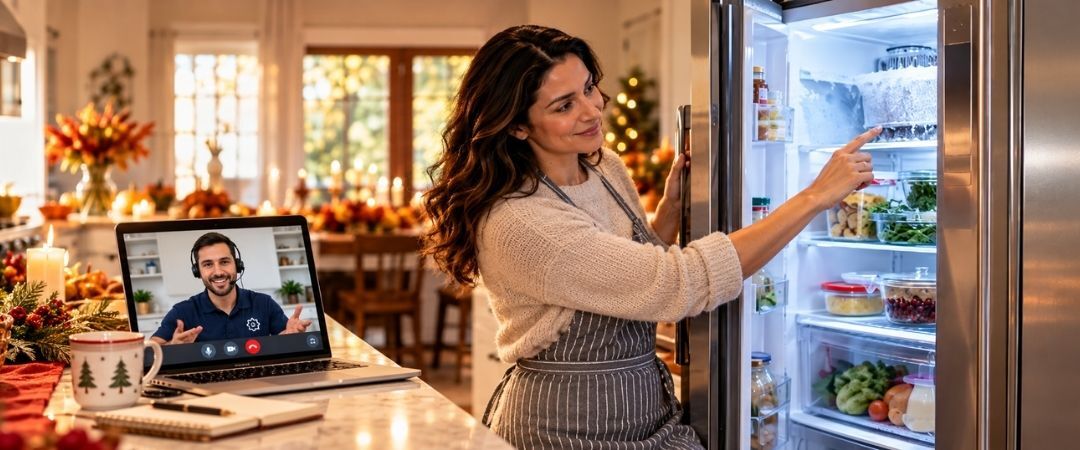

At 7:40 on Thanksgiving morning, a warm refrigerator is not just an appliance problem. It is a thawed turkey, a kitchen full of food, relatives arriving in a few hours, and a customer searching for a number that someone will actually answer.
That is what makes holiday appliance customer service different from an ordinary product-support interaction. The refrigerator, oven, dishwasher, or small kitchen appliance may be the same product your team supports every other week of the year. The customer’s situation is not.
During a major holiday, inconvenience becomes urgency. Customers need to know what they can safely check now, whether the product may require service, what their warranty covers, what happens next, and whether somebody will stay with the issue after the first conversation ends.
For appliance brands, the challenge is therefore not simply handling more contacts. It is making sure technical customer service, warranty support, service coordination, and customer care work together when customers have the least patience for handoffs and uncertainty.
Why a Holiday Appliance Breakdown Feels So Different
Appliances carry more of the household load during major holidays. Ovens run longer. Refrigerators are fuller. Dishwashers cycle repeatedly. Small kitchen appliances that may sit unused for weeks suddenly become essential to preparing meals for a house full of people.
The National Fire Protection Association offers a useful indication of just how unusual Thanksgiving kitchen activity can be. Its research found an average of 1,470 reported home cooking fires on Thanksgiving during 2017–2021, 240% above the average day. That is a fire-safety statistic, not an appliance-failure rate, but it shows how much more intense kitchen use becomes around the holiday.
When an appliance does stop working, two problems arrive at once. The first is technical: What has happened to the product? The second is practical and emotional: What is the customer supposed to do now?
Strong appliance and consumer-electronics customer support has to address both. A technically correct answer that ignores the urgency of the customer’s situation can still feel like poor service.
The First Response Has to Do More Than Open a Ticket
A customer calling about an appliance problem on an ordinary Tuesday may tolerate a standard intake process. On Thanksgiving morning, a long qualification script followed by “someone will get back to you” feels very different.
The first interaction needs to establish four things quickly: what is happening, what the customer can safely check, which support path applies, and what will happen next.
That does not mean frontline agents should improvise repairs. It means they need access to approved troubleshooting steps, product information, warranty rules, escalation paths, and service guidance. If the issue can be resolved safely through basic troubleshooting, the customer gets help immediately. If it cannot, the agent should know exactly where the case goes next.
This is why well-designed product troubleshooting support matters during peak periods. It can prevent unnecessary transfers while helping agents distinguish between questions they can resolve and cases requiring technical or service escalation. The same principle applies to broader technical and product support: customers should not have to understand your internal organization to get the right help.
What the Customer Needs at Each Step After Something Fails
Customer needs: A fast response and reassurance.
Operation needs: Holiday coverage, trained intake, urgency rules.

Customer needs: Useful, safe guidance.
Operation needs: Knowledge base, approved troubleshooting, technical escalation.
Customer needs: Clarity on repair, warranty, replacement, or escalation.
Operation needs: Policy access and decision rules.
Customer needs: A realistic commitment.
Operation needs: Technician, parts, replacement, and callback coordination.
Customer needs: Ownership through resolution.
Operation needs: Status visibility, proactive updates, final follow-up.
If ownership becomes unclear at any one of these five stages, the customer is more likely to call again, escalate, or move to another channel for an answer.
The Problem Often Starts After the First Call
The support journey does not end when the agent diagnoses the issue. A holiday appliance case may move through troubleshooting, warranty verification, service scheduling, parts availability, replacement decisions, and customer follow-up. If those steps sit in disconnected queues, the customer becomes the coordinator.
They call again because the technician date is unclear. They send an email because a promised callback never arrived. They contact social media because warranty and service teams appear to be giving different answers. What started as one product issue begins generating multiple interactions and avoidable escalation. That is why appliance warranty management cannot be treated as completely separate from the customer experience. Warranty rules may determine the resolution, but communication determines whether the customer understands and trusts that resolution.
Where refunds, replacements, claims, or warranty decisions are part of the process, the same principle applies to returns, refunds, and claims support. The customer needs one understandable journey even when several operational teams are involved behind the scenes.
Normal Staffing Can Look Fine Until the Holiday Arrives
This is where many appliance support models come under pressure. Annual headcount may be perfectly reasonable. The problem is that holidays concentrate demand differently. Customers may need help outside normal hours, call with more urgent issues, and require a higher proportion of technical or warranty-related support than on a typical day.
The capacity gap may not even appear everywhere at once. You could have enough customer-care agents but too few people trained for troubleshooting. Voice may look manageable while email and callbacks begin building. Warranty intake may be adequately staffed while technician coordination becomes the bottleneck. That is why peak-season staffing should be planned by workflow, skill, channel, and coverage window rather than total headcount alone.
For brands evaluating whether their existing operation can absorb the surge, our guide to retail peak-season outsourcing looks at the wider capacity decision. Appliance brands should then take the analysis one step further and separate general customer care from troubleshooting, warranty, service coordination, and escalation work.
Build Holiday Coverage Around the Failure Journey
The most useful readiness question is not “How many calls did we get last Thanksgiving?” It is “Where did customers get stuck?”
Look at historical holiday contacts by product type, reason for contact, channel, day, and time. Then look beyond the initial volume. Which issues generated repeat calls? Which cases required supervisor intervention? Where did callbacks accumulate? Which warranty or service handoffs created the longest delays? That gives you a much clearer picture of what additional capacity should actually do.
You may discover that the biggest requirement is not more generic customer service at all. It could be additional technical customer service, stronger after-hours coverage, faster warranty intake, more callback capacity, or better coordination with the service network. This also prevents a common mistake: adding more people to the front of the queue while the real constraint remains further downstream.
Work Backward From the Holiday
Skilled appliance support cannot be created on the morning volume rises. The operation needs time to prepare. Several weeks before peak, review the previous holiday’s contact drivers and expected changes in volume. If new products have launched, warranty policies have changed, or service networks have different holiday availability, historical data alone will not be enough.
Before training begins, refresh troubleshooting guides, escalation rules, warranty processes, holiday operating hours, technician information, and callback ownership. Seasonal or overflow agents can only perform as well as the information and authority they are given. Before holiday week, test the handoffs. If an agent determines that a refrigerator requires service, what happens next? If no technician is available until the following day, what can the agent confidently promise? Who owns an urgent exception? What happens if the customer calls back?
Once the holiday begins, compare actual demand with the plan. Move capacity toward the queues building fastest instead of assuming every workflow will behave exactly as forecast. The wider post-purchase experience for consumer electronics and appliances is especially important here because product defects, delivery damage, troubleshooting, warranty questions, and replacement decisions often overlap.
Where Outsourced Appliance Support Actually Helps
Outsourcing should not mean sending every appliance issue to a generic external queue. The strongest model is usually more deliberate. An appliance brand may keep engineering-level escalations, unusual warranty exceptions, and sensitive product-quality decisions in-house while an outsourced team handles higher-volume workflows such as first-line troubleshooting, warranty intake, service-status inquiries, callback queues, appointment coordination, email support, and extended-hour customer care.
That is where retail technical support outsourcing can become useful. The purpose is not merely to lower cost. It is to add trained, usable capacity exactly where seasonal demand is likely to strain the internal operation.
For one appliance brand, the priority may be holiday and weekend coverage. Another may need additional product troubleshooting because standard customer-care agents cannot resolve technical questions efficiently. A third may have sufficient phone coverage but need help clearing email, warranty, and callback queues before they turn into repeat contacts. That is why outsourced appliance support should be designed around the actual workload rather than a generic agent count.
ServeRetail supports consumer electronics and appliance brands across customer care, technical support, post-purchase workflows, warranty-related inquiries, and other high-volume retail interactions. The operating model can be structured around the workflows, hours, channels, and seasonal capacity the brand actually needs.
Keep the Customer From Becoming the Coordinator
There is one simple test for whether the holiday support model is working: the customer should not have to chase the organization to move the case forward.
When the troubleshooting team identifies a repair need, the next step should be clear. A warranty decision should also have a defined owner, so the customer knows who is responsible. And when service cannot happen immediately, the promised update still needs to arrive when expected.
A customer whose refrigerator fails on Thanksgiving may understand that a technician cannot appear instantly. What is much harder to accept is silence, contradictory information, or repeated requests to explain the same problem to different teams. In high-emotion moments, clarity and follow-through can matter almost as much as speed.
The Holiday Moment Customers Remember Starts Before the Phone Rings
No appliance company can prevent every refrigerator, oven, dishwasher, or small appliance from failing at an inconvenient time. What brands can control is what the customer experiences next.
A useful first answer. Safe and relevant troubleshooting. Clear warranty guidance. A realistic service commitment. Updates without repeated chasing. And someone who remains accountable until the issue reaches a resolution. That level of appliance customer support does not happen because an agent happens to be available on Thanksgiving morning. It comes from planning the journey, the skills, the coverage, and the handoffs before peak demand arrives.
For appliance and consumer-electronics brands expecting higher seasonal contact volumes, the best time to find the coverage gap is before customers find it for you.
ServeRetail helps appliance and consumer-electronics brands add trained customer service, technical support, warranty-related, and post-purchase capacity around holiday and seasonal demand.


