


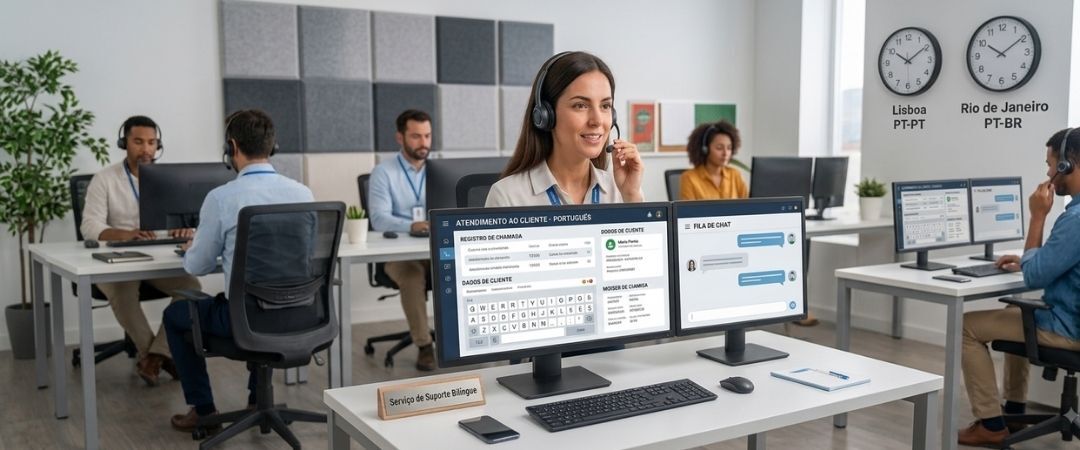

Expanding into a Portuguese-speaking market creates a customer service challenge that can look deceptively simple. Hire Portuguese-speaking agents, translate the knowledge base, and start taking contacts. In practice, that is rarely enough.
A shopper in Portugal and a shopper in Brazil may speak Portuguese. However, they do not necessarily use the language in the same way or interact with the same retail environment. Delivery networks, payment methods, returns processes, terminology, promotions, operating hours, and customer expectations can all differ.
Effective Portuguese retail customer service therefore combines language proficiency with market knowledge and retail execution. Agents need to understand not only what the customer is saying. However, also what was purchased. In this case, the order originated. This policies apply, and what action the brand can take next. For global retailers, that distinction can determine whether Portuguese support feels genuinely local or simply translated.
What This Article Covers
- Portuguese Customer Service Is Not One-Size-Fits-All.
- Where Portuguese Support Matters Across the Retail Journey.
- Portuguese Support Should Follow the Customer Across Channels.
- Where Can Retailers Build Portuguese-Speaking Support Capacity?
Portuguese Customer Service Is Not One-Size-Fits-All
Portuguese is spoken across several markets. However, retailers planning international support will often encounter one fundamental distinction first. European Portuguese and Brazilian Portuguese.
The differences should not be exaggerated into completely separate languages. However, vocabulary, pronunciation, expressions, tone, and everyday usage can vary enough to influence how natural a customer interaction feels.
| Consideration | Portugal | Brazil |
|---|---|---|
| Language requirement | European Portuguese may be preferred or required | Brazilian Portuguese is typically appropriate |
| Retail terminology | Should reflect local Portuguese usage | Should reflect Brazilian usage |
| Customer context | Portugal and the wider European retail environment | Brazilian ecommerce and retail environment |
| Operations | Local fulfillment, delivery, returns, and applicable policies | Brazil-specific fulfillment and customer workflows |
| Agent preparation | European Portuguese capability where the program requires it | Brazilian Portuguese capability where the program requires it |
This is why Portuguese-speaking customer support should begin with the market being served rather than a generic language requirement. The same principle applies more broadly to global retail customer support: customers experience language through local context, not through a translation dictionary.
Where Portuguese Support Matters Across the Retail Journey
Language support becomes valuable when it helps the customer complete an actual retail task. For ecommerce brands, those tasks span the entire buying journey.
Before the Purchase
A customer may need help comparing products, understanding specifications, confirming availability, choosing a size, checking compatibility, or clarifying a promotion.
Here, Portuguese ecommerce customer service can influence conversion. Agents need enough product knowledge to answer naturally rather than simply translate information from an English-language product page.
Between Checkout and Delivery
After payment, the questions change quickly: Has my order shipped? Can I update the address? Why has tracking stopped? When will the package arrive?
Portuguese-language agents need access to the same order information and resolution tools as the retailer’s primary-language team. Connecting support with order management and tracking helps agents investigate the transaction instead of sending generic delivery responses.
This becomes particularly important as international volume grows. As our guide to ecommerce order processing outsourcing explains, operational bottlenecks behind the order can quickly become customer-facing problems.
After Delivery
A product may arrive damaged, incomplete, incorrect, or simply unsuitable. Customers then need clear guidance on returns, refunds, exchanges, replacements, or claims.
A Portuguese-speaking agent must understand the policy that applies to that customer’s transaction. Integrating language support with structured returns, refunds, and claims processing helps prevent a common failure: communicating fluently while giving the wrong operational answer.
Portuguese Support Should Follow the Customer Across Channels
Retail customers do not organize their lives around contact center channels. They may start on live chat, respond by email, and call when an issue becomes urgent. That makes Portuguese omnichannel support more valuable than isolated language queues. Voice, email, chat, and digital interactions should draw from consistent customer history, product information, and policies.

A shopper should not receive natural Portuguese over the phone and then encounter awkward translated responses when switching to chat. Nor should the customer have to repeat an order number and explain the problem again simply because the channel changed.
Our omnichannel retail customer support guide explores this wider requirement: channels become genuinely omnichannel only when context travels with the customer. For international retailers, multilingual customer support should therefore be integrated into the wider CX operation rather than managed as an isolated translation function.
Where Can Retailers Build Portuguese-Speaking Support Capacity?
Choosing a delivery location requires more than finding a market where Portuguese speakers can potentially be recruited. Retailers should evaluate the required Portuguese variant, operating hours, customer geography, channel mix, recruiting depth, program size, scalability. the complexity of the workflows agents will manage.
Within ServeRetail’s Latin American delivery footprint, Colombia, El Salvador, and Belize can be evaluated for Portuguese-speaking recruitment based on program requirements and available talent.
For retailers primarily serving Portugal or European customers, Morocco can also be evaluated as a potential EMEA delivery option when European time-zone alignment is important, subject to the availability and validation of appropriate European Portuguese talent for the specific program. The important point is that delivery geography should follow the customer strategy. A retailer should not choose a location first and attempt to make the language requirement fit afterward.
A Portuguese Knowledge Base Must Localize Operations, Not Just Words
A useful way to structure Portuguese support knowledge is through three layers.
- Global brand knowledge: product information, brand voice, service principles, warranties, approved positioning, and common troubleshooting.
- Portuguese-language knowledge: approved terminology, tone guidance, product vocabulary, written standards, and linguistic quality requirements appropriate to the customer market.
- Market-specific operational knowledge: delivery processes, currencies, return procedures, promotions, escalation paths, fulfillment rules, and other workflows specific to the market being served.
This model creates consistency without forcing every Portuguese-speaking customer into the same script.
It is especially important for cross-border sellers. As ServeRetail has examined in its analysis of cross-border commerce and European retail support, international ecommerce creates complexity at the intersection of language, logistics, policies, and customer expectations.
How Should Retailers Measure Portuguese Customer Service Quality?
Hiring Portuguese speakers is only the beginning. Quality assurance must determine whether agents are actually delivering accurate retail support. A strong QA framework should evaluate linguistic accuracy, natural communication, product knowledge, policy adherence, documentation, empathy, resolution quality, and compliance with brand standards. That distinction matters. A grammatically perfect Portuguese response that gives the wrong return instruction is still a failed customer interaction.
Retailers should also calibrate quality regularly across agents and channels. Recurring terminology errors, unnecessary transfers, repeat contacts, policy confusion, and weak resolution rates can reveal where training or knowledge needs improvement. For larger operations, structured quality management can help brands maintain consistency as contact volumes, channels, and agent populations expand.
When Does Outsourcing Portuguese Customer Service Make Sense?
Not every retailer needs an outsourced Portuguese operation. A business with manageable volumes and sufficient internal language expertise may be able to support the market effectively in-house.
Multilingual customer service outsourcing becomes more relevant when Portuguese volumes exceed internal capacity, a retailer enters a new market, service hours expand, new channels are added, seasonal demand creates staffing pressure, or recruiting appropriate language proficiency becomes difficult. For ecommerce brands, ecommerce customer service outsourcing can also consolidate Portuguese support with order management, delivery inquiries, returns, and other customer workflows instead of maintaining a separate language-only team.
The decision should still be based on operational fit rather than outsourcing for its own sake. Retailers evaluating that choice can use our comparison of in-house versus outsourced ecommerce customer support to assess the trade-offs around control, scalability, technology, and operating requirements.
What Should Retailers Ask a Portuguese Customer Service Provider?
A provider offering a Portuguese call center solution should be able to explain much more than where its agents are located.
- Which Portuguese variant will agents support for our customer base?
- How do you validate spoken and written Portuguese proficiency?
- How are agents trained on our products, orders, returns, and customer policies?
- Can Portuguese support operate consistently across voice, email, and live chat?
- How do you separate market-specific workflows within the knowledge base?
- How is Portuguese-language quality evaluated and calibrated?
- What happens when an agent encounters an exception they cannot resolve?
- How can staffing expand during launches, promotions, and seasonal peaks?
The answers help distinguish genuine retail CX capability from a provider that simply has Portuguese-speaking employees.
Portuguese Support Should Scale With the Market
The question for an expanding retailer is not simply, “Can we offer customer service in Portuguese?” The better question is whether customers can receive Portuguese support that makes sense for where they live, what they purchased, how the order is being fulfilled, and what they need the brand to do next.
That requires the right combination of language proficiency, market context, retail knowledge, connected channels, quality assurance, and scalable operations.
ServeRetail’s Portuguese call center services can support retailers evaluating Portuguese-language customer experiences as part of a wider ecommerce customer support strategy.
For a related angle on native-language support, see Why Italian-Speaking Customer Support Matters for Fashion and Lifestyle Brands.
If your brand is planning to expand into Portugal, Brazil, or other Portuguese-speaking customer markets, begin by defining the customers, language variants, workflows, channels, operating hours, and quality requirements the program actually needs. Discuss your Portuguese support coverage with ServeRetail and evaluate the delivery model that best fits your customers and growth plans.


