


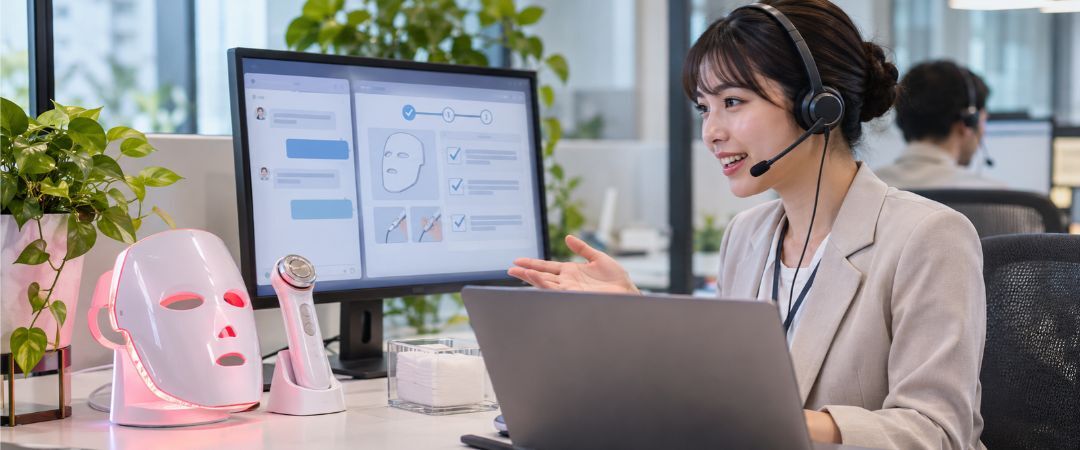

A customer unboxes a premium at-home beauty device on Friday evening. The device powers on, but the companion app cannot find it. After checking the instructions and restarting her phone, she contacts customer support. The agent asks her to repeat the same troubleshooting steps before suggesting a return.
The device may not be defective. The problem could involve app permissions, device compatibility, or a setup step that was missed. Yet without the right support process, a potentially resolvable issue can turn into a return request, a negative review, or a lengthy warranty case.
Beauty device technical support requires more than agents who can answer product questions. Brands selling IPL hair removal devices, LED light therapy masks, microcurrent tools, and connected skincare equipment need trained representatives who understand approved troubleshooting procedures, technical limitations, warranty workflows, and safety escalations.
For beauty electronics manufacturers and DTC brands considering beauty device technical support outsourcing, the important question is which responsibilities an external team can manage effectively and where manufacturer specialists must take over.
This guide examines those decisions, from Tier 1 troubleshooting and warranty handoffs to agent training, performance measurement, and selecting a technical support outsourcing partner.
Why Beauty Device Technical Support Is Different from Ordinary Beauty Customer Care
A customer asking whether a foundation is available in another shade has a different support requirement from someone reporting that an electronic skincare device will not charge.
Traditional beauty customer care often focuses on product information, order status, returns, and purchase assistance. Electronic beauty products introduce technical questions involving hardware, software, accessories, compatibility, and manufacturer instructions. The difficulty increases when a brand sells several device models with different operating procedures.
For example, a customer may report that an IPL hair removal device displays an unfamiliar indicator. Another might struggle to connect a smart skincare tool to a mobile application. A third could experience an unexpected shutdown during operation.
Although all three customers need assistance, their inquiries should not follow the same troubleshooting script. An effective beauty electronics customer support operation must account for:
- Model-specific information: Correct instructions for the customer’s device, version, and accessories.
- Technical troubleshooting: Approved checks for charging, connectivity, controls, and software issues.
- Safety-related complaints: Prompt recognition and escalation of suspected injuries, overheating, or unusual device behavior.
- Warranty administration: Consistent documentation, eligibility checks, and approved replacement procedures.
- Product updates: Changes to firmware, applications, manuals, and support guidance.
Brands already familiar with beauty tech support services for smart skincare devices will recognize many of these customer challenges. The additional outsourcing decision is how to divide the work between external support agents, internal technical specialists, and authorized warranty teams.
Where Should Tier 1 Support End and Manufacturer Escalation Begin?
One of the most important decisions in beauty device technical support outsourcing is defining what external agents are permitted to resolve independently.
Tier 1 support should handle documented, repeatable issues that fall within approved procedures. Cases involving suspected hardware defects, safety concerns, unusual device behavior, or decisions outside established policies should move to the responsible specialist. A clear escalation framework helps agents avoid guessing and allows manufacturers to retain control over sensitive technical decisions.
| Customer inquiry | Outsourced Tier 1 support | Manufacturer or specialist escalation |
|---|---|---|
| First-time device setup | Explain approved setup instructions and accessory requirements | Unresolved setup faults or undocumented behavior |
| Charging or power problem | Complete permitted checks from the manufacturer’s guide | Suspected electrical defect, overheating, or persistent failure |
| Bluetooth or app connectivity | Check documented compatibility and pairing procedures | Firmware errors, application defects, or unresolved connectivity problems |
| Warranty request | Collect purchase details, document symptoms, and initiate approved workflows | Disputed coverage, exceptional replacements, or repair authorization |
| Skin reaction or suspected injury | Document the report and follow approved safety-response procedures | Prompt review by the designated safety, medical, or product complaint team |
| Missing or defective accessory | Check model compatibility and approved replacement eligibility | Unclear compatibility, repeated defects, or out-of-policy requests |
Illustrative responsibility matrix. Actual support authority and escalation procedures must follow the manufacturer’s product documentation, safety requirements, and approved policies.
For a manufacturer, the objective is not to maximize the number of cases closed by Tier 1 agents. It is to resolve appropriate inquiries accurately while ensuring that cases requiring technical or safety expertise reach the right people.
What Can an Outsourced Beauty Device Technical Support Team Actually Handle?
The most suitable activities are those that can be documented, trained, monitored, and resolved through established procedures.

Product Setup and First-Use Assistance
Some customers need help before they can use their device for the first time.
An agent might explain where to find the correct manual, how to identify the supplied accessories, which manufacturer-approved setup steps apply, or how to interpret standard charging indicators. The support process should begin by identifying the device model and understanding what the customer has already tried.
These details prevent repetitive instructions and make subsequent troubleshooting more useful. Structured product setup support outsourcing can help brands manage these early ownership interactions when internal teams are handling growing customer volumes.
Charging, Controls, and Connectivity Troubleshooting
Electronic beauty products may generate inquiries involving power connections, battery performance, device controls, app permissions, or accessory recognition.
Outsourced agents can follow approved diagnostic steps, record error messages, check documented compatibility requirements, and determine whether the issue is suitable for further Tier 1 troubleshooting.
Consider a customer whose connected facial device is not pairing with an application. The agent may be able to confirm the supported operating-system version and guide the customer through the manufacturer’s documented pairing process. If the problem continues, the case should move to an authorized specialist with the relevant troubleshooting history attached.
This kind of structured product troubleshooting support can help teams maintain consistent diagnostic procedures without relying on improvised responses.
Warranty Questions and Replacement Administration
Customers with suspected device defects frequently need help understanding warranty eligibility and the next steps. External agents can gather purchase information, identify the product model, document the reported issue, explain published coverage terms, and initiate an approved return merchandise authorization (RMA) process.
Where the manufacturer permits it, the team may also manage routine follow-ups involving replacement status, required documentation, or shipping updates. However, disputed warranty eligibility, out-of-policy replacements, and technical decisions about suspected defects should follow the manufacturer’s authorization rules.
Customer Communication During Technical Investigations
Not every problem can be resolved during the first interaction. When a device requires specialist investigation, customers should receive a clear explanation of what happens next. The support team can manage permitted status updates and coordinate follow-ups while the technical team investigates. This prevents cases from becoming inactive simply because responsibility has moved between departments.
The Warranty Handoff: What Happens After Troubleshooting Fails?
Imagine a customer contacting support because a premium LED device repeatedly stops working during normal operation. The agent verifies the model, follows the approved troubleshooting guide, and confirms that the problem remains unresolved.
At this point, repeating the same steps is unlikely to help. The support operation needs a clear handoff from troubleshooting to warranty review. A practical workflow might look like this:
- Document the issue: Record the device model, reported symptoms, relevant error indicators, and permitted troubleshooting steps already completed.
- Check available warranty information: Review the purchase details, registration records, and applicable manufacturer policy.
- Determine the next authorized action: Route suspected defects or exceptions to the appropriate technical or warranty decision-maker.
- Initiate approved processing: If authorization is received, create the RMA or replacement request according to established procedures.
- Maintain customer communication: Explain the next steps, document promised follow-ups, and provide available status updates.
The handoff matters because a customer experiencing a device problem should not have to restart the entire conversation when the case reaches the warranty team.
For brands evaluating the administrative side of this process, our guide to warranty claims processing and management explains the wider requirements for claims documentation, approvals, and resolution workflows.
Why Safety Escalations Must Be Built into Beauty Device Support
Not all technical inquiries involve routine product faults. Customers using light-based or skin-contact devices may report unexpected reactions, discomfort, overheating, or unusual device behavior. These situations require specific procedures rather than ordinary troubleshooting scripts.
The U.S. Food and Drug Administration explains that LED and intense pulsed light products fall within the broader category of radiation-emitting products, with manufacturer obligations depending on the product and applicable requirements. Its radiation-emitting product guidance discusses distinctions between lasers, LEDs, and IPL equipment.
For beauty device manufacturers, the operational implication is straightforward: support representatives must understand the limits of their responsibilities. If a customer reports a suspected injury, unusual skin reaction, or potentially unsafe device condition, the agent should follow the manufacturer’s approved immediate response and escalation process.
Support agents should not independently diagnose a reaction, decide whether a customer is medically suitable for a treatment, recommend unapproved device settings, or override product safety instructions. Where appropriate, the manufacturer’s procedures should also address complaint documentation, specialist review, and any applicable regulatory reporting obligations.
How Do You Train Outsourced Agents Across Multiple Beauty Device Models?
Technical support becomes harder when a brand introduces new products without updating the information available to its customer service teams. A device manufacturer may sell several versions of an IPL tool, each with different accessories or controls. Another brand might release software updates that change how a connected skincare product works.
Agents need accurate instructions for the specific model involved in each inquiry. The knowledge base should therefore include:
- Current user manuals and approved setup instructions.
- Model-specific troubleshooting procedures and known error messages.
- Compatible accessories, charging equipment, and software requirements.
- Warranty policies and replacement eligibility rules.
- Safety warnings and mandatory escalation triggers.
- Approved documentation and customer communication templates.
- Version histories showing changes to product instructions and support procedures.
Training should test how agents apply this information to customer situations. For example, a representative should recognize the difference between a missing charging accessory and a customer reporting that a device becomes unusually hot during use. The first may be an administrative or compatibility issue; the second requires an approved safety response.
Product updates should trigger a controlled knowledge review. If the manufacturer changes a troubleshooting instruction or identifies a new issue, support teams need the revised guidance before continuing to advise customers.
How to Evaluate Beauty Device Technical Support Outsourcing Providers
A prospective outsourcing partner should explain how it will handle technical inquiries before presenting a staffing proposal. For beauty electronics brands preparing an RFP or considering their first outsourced support program, the following questions can help assess operational readiness.
Can the Provider Support Our Device Portfolio?
Start with the number of product models, their technical differences, expected contact volumes, and the complexity of troubleshooting required. Ask how agents will access current product documentation and what happens when new devices or software versions are released.
Where Does Tier 1 Authority End?
The provider should be able to identify which troubleshooting steps agents may complete independently, which require authorization, and which must be escalated immediately. Request a documented responsibility matrix rather than a general promise to resolve every technical inquiry.
How Will Technical Quality Be Reviewed?
Speed matters, but a fast answer is not useful when it is technically incorrect. Quality reviews should assess whether agents identified the correct model, followed approved diagnostic steps, documented the interaction, and recognized relevant escalation conditions.
Can the Team Support Warranty and RMA Workflows?
Confirm who can verify warranty eligibility, collect evidence, create case records, approve replacements, and communicate repair or shipping status. These responsibilities should be documented before operations begin.
How Will Support Scale During Product Launches?
A new device launch may generate unfamiliar questions about setup, compatibility, accessories, and expected operation. Ask how the provider prepares training materials, forecasts contact demand, manages launch-related escalation queues, and adds trained capacity when inquiry volumes increase.
What Will the Operating Model Cost?
Beauty device customer service outsourcing proposals should specify whether pricing is based on dedicated agents, shared support capacity, operating hours, or another agreed structure.
The scope should also explain which services are included, such as training, quality assurance, reporting, supervision, warranty administration, and specialist escalation coordination.
Comparing providers solely on an hourly staffing rate may overlook the operational work required to manage technical support accurately. Brands evaluating the wider business case can refer to our article on retail technical support outsourcing and return-related costs.
What Should a Beauty Device Support Pilot Measure?
Before committing to a large outsourcing program, manufacturers can evaluate a defined set of products and inquiry types through a controlled pilot. A pilot might cover approved setup assistance, routine connectivity questions, warranty-status inquiries, and basic troubleshooting for selected device models. The manufacturer should establish baseline performance and agree on measurement definitions before the pilot begins.
| KPI | What it helps evaluate |
|---|---|
| First-contact resolution | Whether eligible technical inquiries are resolved without additional customer contact |
| Technical QA accuracy | Whether agents follow approved model-specific troubleshooting procedures |
| Escalation compliance | Whether cases requiring specialist review are identified and routed correctly |
| Repeat-contact rate | Whether unresolved technical problems generate further customer contacts |
| Warranty case turnaround | How efficiently authorized claims and replacement workflows are processed |
| Customer satisfaction | How customers evaluate their support experience after assistance |
Manufacturers should also review recurring issues by device model. A sudden increase in charging complaints, for example, may require investigation beyond the contact center.
Safety-related escalations deserve separate monitoring. A lower escalation count is not automatically a sign of improvement if agents are overlooking cases that require specialist attention. Likewise, average handling time should never encourage agents to rush customers through technical or safety procedures.
What Can Beauty Brands Learn from an Established Omnichannel Support Operation?
Technical support for beauty electronics requires product-specific knowledge. However, the underlying service operation also depends on reliable staffing, clear case ownership, customer communication, and quality monitoring.
A relevant example comes from ServeRetail’s work with a global beauty brand.
RELEVANT SERVRETAIL CASE STUDY
Global Beauty Brand Maintained 99%+ Omnichannel Service Levels
ServeRetail supported a global beauty and personal care brand through customer engagement operations involving multiple channels and markets. The engagement demonstrates experience managing service delivery, customer communication, and operational performance in the beauty sector.
Reported result: 99%+ service levels across the documented omnichannel engagement.
This case study does not represent a beauty-device troubleshooting or safety-support program. Its relevance is the underlying customer service delivery and operational coordination.
For a beauty electronics manufacturer, similar operational disciplines can support a dedicated technical assistance program once the required device knowledge, troubleshooting controls, warranty responsibilities, and escalation processes have been established.
How ServeRetail Supports Beauty Electronics and At-Home Device Brands
ServeRetail provides technical and product support outsourcing for retail and ecommerce operations. For beauty electronics brands, a support engagement can be structured around manufacturer-approved setup assistance, product troubleshooting, technical inquiry handling, warranty support, customer communication, and specialist escalation.
The exact service scope depends on the product portfolio, technical complexity, operating hours, customer contact volumes, and responsibilities the manufacturer is prepared to delegate.
ServeRetail’s broader Cosmetics & Beauty customer support solutions address the customer experience needs of beauty brands, while a technical support program can be tailored to the additional requirements of electronic devices.
For a manufacturer considering outsourcing, the starting point is a clearly defined operating scope. That includes product categories, approved troubleshooting procedures, agent permissions, quality standards, warranty workflows, and escalation ownership.
Beauty Device Technical Support: Frequently Asked Questions
Can beauty device technical support be outsourced?
Yes. Manufacturers can outsource defined Tier 1 support activities such as setup assistance, approved troubleshooting, customer communications, warranty administration, and routine technical inquiries. Product safety decisions, specialist investigations, and exceptions outside approved procedures should remain with authorized teams.
Can outsourced agents support IPL hair removal devices?
Agents can provide manufacturer-approved product information and permitted setup assistance within their training. They should not independently assess treatment suitability, diagnose adverse reactions, or recommend actions inconsistent with the device’s instructions or labeling.
What is included in beauty device warranty support?
Depending on the agreed scope, warranty support may include eligibility checks, documentation collection, case registration, RMA administration, replacement-status updates, and customer follow-ups. Exceptional approvals should follow manufacturer-defined authority limits.
What should manufacturers look for in a beauty device support partner?
Key considerations include experience managing technical workflows, product training, knowledge management, escalation accuracy, warranty administration, quality monitoring, secure system access, and the ability to scale support during product launches.
How can brands assess whether outsourcing is working?
Compare pilot performance against agreed baselines for technical accuracy, first-contact resolution, repeat contacts, escalation compliance, warranty turnaround, and customer satisfaction. Review safety-related cases separately from routine inquiries.
Is Your Beauty Device Support Operation Ready to Scale?
Customers purchasing at-home beauty devices expect reliable assistance when setup becomes confusing, a product stops working, or a warranty question arises. For manufacturers, meeting those expectations requires product-specific knowledge, consistent troubleshooting, clear escalation ownership, and timely customer communication.
Beauty device technical support outsourcing can provide additional operational capacity when these responsibilities are properly defined and managed. The right outsourcing model should make routine support easier to handle without weakening the manufacturer’s control over product information, technical decisions, or customer safety.
Need Technical Support for Your Beauty Device Customers?
Tell ServeRetail about your device categories, approximate monthly support volume, product setup questions, common technical issues, warranty requirements, and existing escalation procedures.
We can discuss an outsourced technical support model built around your products, approved workflows, customer coverage requirements, and quality expectations.


