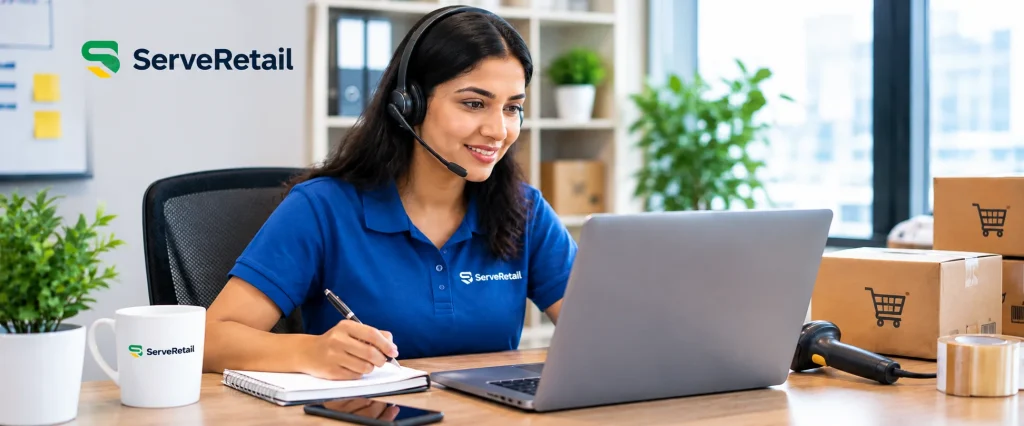






For most U.S. retail brands, the in-house customer support model made sense, until it did not. Hiring cycles that could not keep pace with peak season. Technology costs that kept climbing. Agents handling the same repetitive queries, while complex issues went unresolved. US retail customer service outsourcing has moved from a fringe option to the mainstream response to exactly these pressures.
The shift, however, is not about cutting corners. It is about building a support operation that actually scales, one that absorbs volume surges, serves bilingual customer bases, and delivers consistent CX without the overhead of managing it all internally. This guide walks through how US retailers are making that transition, what the right model looks like, and how to avoid the decisions that cost brands more than staying in-house ever would.
Why In-House Retail Support Breaks Down at Scale
Most retail brands build their support operations re-actively. A small team handles customer queries. Volume grows. More agents are hired. Another channel is added. Before long, the operation is held together by spreadsheets, siloed systems, and institutional knowledge that lives in the heads of three people who might leave next quarter.
The structural problem, however, runs deeper than staffing. Three specific pressure points expose in-house retail customer support for what it really is, a model built for average days, not peak ones:
- Technology gaps, In-house teams rarely have real-time OMS connectivity, omnichannel platforms, or AI quality monitoring built in. Constructing that infrastructure internally takes 12 to 18 months, and the capital is better directed toward product and growth for most retail brands.
- Peak season fragility, A team sized for average daily volume cannot absorb a Black Friday spike without degraded service, long queues, and CSAT scores that take months to recover.
- Scaling cost – Hiring, onboarding, and then scaling back down after peak season costs money in both directions. Outsourced retail call center services absorb that cycle without the brand carrying the overhead.
Taken together, these pressures explain why US retail brands are not just outsourcing to cut costs. They are outsourcing to build an operation that holds up when it matters most. The direction of travel is clear, according to Deloitte’s Global Outsourcing Survey, 80% of executives plan to maintain or increase their investment in third-party outsourcing, signaling that this is now a growth strategy rather than a cost-reduction exercise. Understanding which delivery model achieves that for retail specifically is where the decision really begins.
The Three Models Every U.S. Retailer Is Evaluating
US retail customer service outsourcing is not a single decision. It is a choice between three fundamentally different delivery models, each with its own cost structure, capability profile, and fit for different retail use cases.
Onshore
US-based agents, US-based operations, and US-based accountability. Onshore retail BPO runs between $30 and $34 per hour, the highest-cost model, but the strongest for regulatory alignment, native communication, and premium brand interactions. For luxury and lifestyle retailers and high-value customer segments where tone and nuance define the relationship, onshore remains the right call for escalations and complex resolutions.
Nearshore
LATAM and Caribbean-based, primarily Belize, Colombia, Jamaica, and El Salvador, for US retail brands. At $12 to $16 per hour, nearshore delivers 50 to 60 percent cost savings versus onshore while maintaining timezone alignment, English fluency, and the cultural proximity that US consumers expect. Moreover, bilingual English-Spanish capability from Colombia and El Salvador serves the US Hispanic market natively, without the cost premium of onshore bilingual staffing. This is the fastest-growing model in US retail BPO solutions today, and the commercial reasons are straightforward.
Offshore
Philippines and India-based operations typically pay $8 to $12 per hour. Offshore delivers the deepest cost savings and excels at high-volume, process-driven work, back office support, technical product troubleshooting, inventory processing, and overnight coverage. For consumer electronics and appliances brands managing complex post-purchase support at scale, offshore is not a compromise; it is the right tool for the job.
For a deeper comparison of how these models perform across specific retail scenarios, read our analysis of nearshore vs offshore BPO for retail.
Why Nearshore Is Now the Default Choice for US Retail BPO
If you ask US retail operations leaders where their customer support is moving, the answer is increasingly toward nearshore locations. The data supports it, according to Auxis Nearshore Outsourcing Research, 90% of organizations considering new outsourcing destinations are now evaluating Latin America specifically for its proximity and skilled workforce. The shift is not driven by a single factor; it is the combined weight of four operational advantages that offshore models simply cannot replicate in US-based retail BPO services.
Timezone alignment
When a WISMO surge hits at 7 pm EST on a Friday before a long weekend, nearshore agents in Colombia and Belize are still on shift. Agents operating from Asia are not. Real-time collaboration with internal US retail teams, same-day escalation resolution, and peak-season support without overnight hand-offs; these advantages compound over thousands of monthly contacts. For more on how WISMO drives contact volume, read our guide on reducing retail WISMO calls.
Bilingual capability at nearshore cost
The US Hispanic consumer market is one of the most significant growth segments in American retail. Serving it well requires agents for whom Spanish is a first language, not translated scripts. Nearshore US-based retail support from Colombia, El Salvador, and Belize delivers genuine bilingual capability at a cost structure that makes commercial sense. Onshore bilingual staffing at $32-$34 per hour does not.
Cultural proximity
US consumer expectations regarding resolution speed, direct communication, and service warmth are well understood by LATAM and Caribbean agents. This shows up measurably in CSAT scores, escalation rates, and first contact resolution data. Retailers who have moved from offshore-only to nearshore-first models consistently report CSAT improvement within the first quarter of transition.
Cost efficiency that holds up under scrutiny
At $12 to $16 per hour, nearshore retail BPO outsourcing delivers a cost structure that makes genuine operational sense without sacrificing the quality that US consumers expect. That is the sweet spot that has made nearshore the default starting point for US retail brands evaluating retail customer service outsourcing for the first time, and the model most established operators are consolidating toward.

Where Offshore Delivers Superior Value
Nearshore is not the answer to everything, and the strongest US retail outsourcing operations know this. Writing off offshore entirely is an operational mistake because three specific retail use cases consistently favor it over every other model.
Back office processing is where offshore shines most clearly. Order data management, catalog processing, inventory reconciliation, and returns documentation all require accuracy and volume capacity more than real-time voice communication. Consequently, offshore teams handle these workflows at a cost and scale that nearshore simply cannot match. For more on what changes operationally when these functions are outsourced, read our breakdown of outsourcing retail back office operations.
Technical product support is the second area where offshore consistently excels. Philippines-based retail call center services have evolved into sophisticated technical hubs, particularly for consumer electronics and appliance brands, where post-purchase troubleshooting and warranty processing require deep, consistent technical knowledge delivered at scale.
Overnight coverage at genuine 24/7 depth is only cost-effective through offshore delivery. Running an offshore overnight shift alongside a nearshore daytime operation is the hybrid model that delivers full coverage without the cost of two nearshore shifts running simultaneously.
As a result, the most strategically sophisticated US retail brands are not choosing between nearshore and offshore, they are running both. Nearshore handles real-time customer-facing interactions during business hours. Offshore handles back office and overnight processing. Together, they form a retail BPO operation that is more capable than either model alone.
How US Retail Brands Evaluate Customer Service Outsourcing Partners
Choosing the right partner matters more than choosing the right model. A well-structured nearshore operation run by the wrong partner will underperform a carefully managed offshore operation run by a genuine retail specialist. The evaluation comes down to three areas, each with a question that separates real retail BPO expertise from a convincing sales presentation.
Capability and retail expertise
Does the partner understand order lifecycles, returns workflows, and loyalty program management, or are they a generic BPO applying a standard playbook to a retail client? Three signals separate genuine retail specialists from generalists:
- Retail-specific agent training – On order lifecycles, returns workflows, escalation paths, and retail-specific compliance requirements, not generic customer service scripts
- Bilingual delivery verified by channel, A bilingual agent pool that only handles email is not a bilingual retail operation; verify Spanish capability across voice, chat, and digital channels specifically
- Multi-model delivery, A partner locked into one geography cannot build the hybrid nearshore-offshore operation that most US retail brands ultimately need as they scale
Technology and integration
Real-time OMS and CRM connectivity – Shopify, Salesforce, Zendesk – must be live within the onboarding window, not after months of IT work. If agents cannot see order data from day one, the operation will not deliver. Beyond connectivity, three technology capabilities now separate genuine retail BPO partners from call centers with retail clients:
- Omnichannel agent desktop – Voice, chat, email, and social unified in a single view; for more on why this matters operationally, read our guide on omnichannel retail customer support
- AI quality management, 100 percent interaction monitoring, not random sampling; ask specifically how quality data is reported and acted upon between review cycles
- Integration speed – Ask how long system connectivity takes for your specific tech stack before signing; slow integration is the most common reason new outsourcing relationships underdeliver in the first quarter
Commercial structure
Transparent pricing and demonstrated scalability are the two commercial signals that matter most. Itemized quotes with no hidden setup fees, seat minimums that match actual volume, and independently verified PCI DSS, SOC 2, and ISO compliance are the non-negotiables before any contract is signed. Beyond the paperwork, ask for a specific Black Friday or peak-season case study that includes actual contact volume data. A retail BPO company that cannot produce one is not a retail BPO company, it is a call center with retail clients.
For a full partner evaluation framework, read our guide on choosing the right retail contact center partner.
The Real Cost of Getting This Wrong
A failed outsourcing transition is not a line item; it is a brand event. US retail brands that have unwound a poorly chosen BPO partnership know the actual cost: CSAT that takes two quarters to recover, customer churn during the transition period, and the internal disruption of rebuilding an operation that was never properly structured in the first place.
The most common failure modes are entirely predictable. Selecting purely on the hourly rate without evaluating the timezone fit. Choosing a generic BPO without retail domain expertise. Committing to a single delivery model without the flexibility to scale across nearshore and offshore as the operation matures. Furthermore, underestimating the cost of the technology integration gap in handling time, repeat contacts, and escalations every day quietly and continuously compounds the damage.
US retail customer care, both in the USA and internationally, confirms the same conclusion, outsourcing done right is not a procurement decision. It is an operational strategy. The brands that treat it as one, choosing partners for capability rather than cost alone, are the ones building support operations that outlast contract cycles and deliver measurable CX improvement year over year.
For more on how retail brands are turning support into a commercial growth driver, read our piece on why retail customer support has become a growth strategy.
Build the Right Operation, Not Just the Cheapest One
The nearshore vs offshore debate is ultimately a distraction from the real question. The right delivery model is the one structured around your retail brand’s specific contact profile, customer demographics, peak season shape, and growth trajectory, not the one with the lowest headline rate.
What is clear is that US retail customer service outsourcing has matured well beyond simple labor arbitrage. The US retailers winning on customer experience are not chasing the lowest hourly rate. Instead, they are building structured outsourcing partnerships, with the right mix of nearshore and offshore delivery, genuine retail expertise, and technology integration that enables consistent CX at scale. According to Clutch’s BPO Pricing Guide, the difference between getting the model right and wrong can represent a cost swing of $20 or more per agent hour, a gap that compounds significantly across a mid-sized retail contact operation.
That connects to a related shift worth watching in retail CX, something we explore further in Mass vs. Prestige Beauty: The Great Consumer Value Shift of 2025.
Ready to build a US retail call center outsourcing model that works for your brand? Contact us about designing the right mix of nearshore and offshore delivery for your retail operation.