






If you’re a retail VP of customer experience sitting down to write your 2026 contact center RFP, there’s a quiet assumption underneath the whole document that’s about to cost you money. The assumption is that “outsourcing your customer service to the Philippines” is one thing. It isn’t. Not anymore.
In 2025, two very different kinds of operations competed for the same Filipino talent, the same office buildings, the same overnight shifts. One is the traditional retail BPO that probably picks up your calls today. The other is something called a Global Capability Center, or GCC. They look similar on paper. They behave nothing alike. And if your RFP doesn’t distinguish between them, you’re going to either overpay or lose your best agents, or both.
Here’s the situation, and what to do about it.
What a GCC Actually Is, and Why It Matters to a Retail Brand
A Global Capability Center is what happens when a large company decides to stop outsourcing and instead build its own captive operation in a low-cost geography. JPMorgan has one. Lufthansa has one. Walmart has one. They hire directly, own the real estate, and manage the agents themselves. The Philippines has become one of the world’s top destinations for GCCs because English is widely spoken, labor costs are roughly a third of US levels, and the country’s new CREATE MORE tax incentive package, passed in late 2025, has made the math even more attractive.
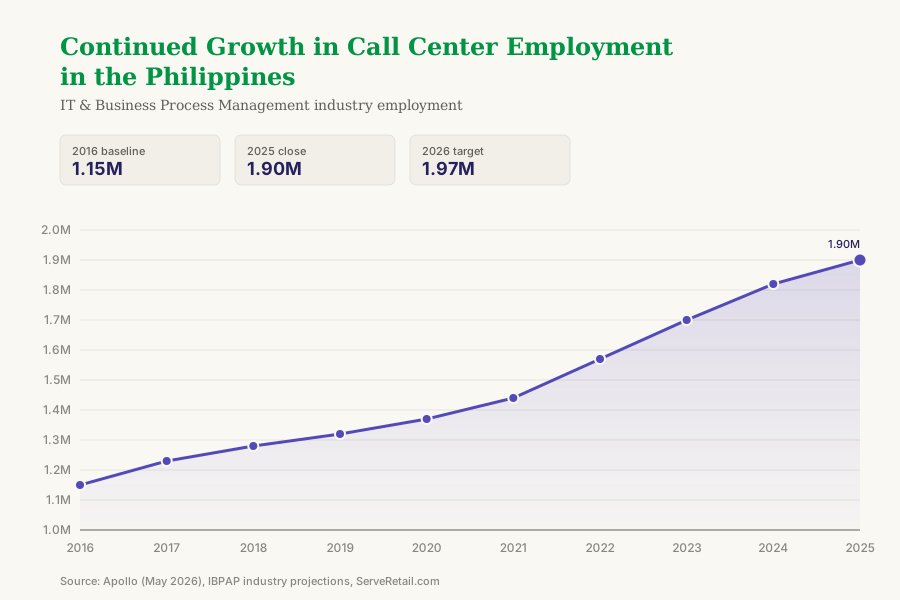
Per Apollo, IT and business processing industry employment in the Philippines (the call center capital of the world) rose from 1.15 million in 2016 to 1.9 million in 2025, straight through every major leap in AI capability. The industry’s trade group IBPAP (IT & Business Process Association Philippines) projects that another 70,000 jobs will be added, a 3.7% year-over-year increase. That growth isn’t evenly distributed. The traditional voice-agent role is plateauing. The GCC role, business intelligence, project management, transformation, and analytics, is where the curve is steepening.
For a retail brand, this matters in three concrete ways.
The talent fight is changing your unit economics
First, GCCs and BPOs are now hiring from the same pool. A captive at a global bank can offer a Filipino agent a clearer career path, more interesting work, and often better benefits than a BPO can. The result, very visibly in 2025, is that the strongest agents in any given Manila or Cebu market drift toward GCCs over time. The BPO industry’s response has been to raise wages and lean harder on technology to maintain service quality. Both of those costs land in your contract sooner or later.
And the pressure isn’t just coming from captives. Australian retail brands have been steadily expanding their Philippine outsourcing footprint over the last three years, drawn by the time zone overlap, the shared English fluency, and the cultural fit that AU customers respond well to on the phone. That’s good news for the Philippines as a delivery geography, but it also means US retail brands are now competing for the same Manila and Cebu seat capacity against Australian grocery chains, AU department stores, and AU ecommerce players who often pay above the prevailing US rate to lock in shift coverage. When an Australian retailer signs a 500-seat contract, the agents staffing it didn’t appear out of thin air. They came from somewhere, often a US brand’s queue.
If your RFP is benchmarking 2026 rates against a 2022 rate card, the rate card is wrong. Wages in the major Philippine cities rose meaningfully in 2025, and the IBPAP guidance for 2026 makes clear that pressure isn’t easing. A retail brand that wants to keep voice quality intact and not give up on cost has to start asking different questions.
Most retail brands don’t have the volume to justify a GCC
Second, and this is the part most retail leaders don’t think through clearly: building a captive in the Philippines is a 24-month, multimillion-dollar commitment. You need legal entity setup, real estate, recruiting infrastructure, training systems, attrition management, payroll, compliance, IT, and a senior leader on the ground. Most retail brands, even ones doing $1 billion in revenue, don’t have the contact volume to justify that overhead. A typical mid-market retailer needs 150 to 600 agents for peak season and far fewer in the trough. That’s a profile that completely breaks the GCC economic model.
Which means the real choice isn’t BPO versus GCC. It’s: how do you get GCC-level capability through a BPO partner so you don’t have to build one yourself?
The proprietary technology question is the new RFP question
Third, this is where the 2026 RFP needs an entirely new section. Old RFPs asked about agent attrition, training duration, and shrinkage. The new RFP needs to ask what proprietary technology your BPO has built that closes the gap with what a GCC would give you.
That means asking specifically: what does your partner do about agent accent neutralization in real time? What does their AI-driven quality management look like, and how much of your interaction volume does it actually score? Do they have voice AI agents that can deflect simple tier-one queries before they hit a human? Without good answers to those three questions, your BPO is selling you 2019 economics in a 2026 talent market, and you’ll feel it within two quarters.
What this Means for Your 2026 Retail Contact Center Contract
The retail brands that are getting this right in 2026 are doing three things.

They’re consolidating their voice volume with a smaller number of specialized partners who genuinely understand retail, rather than spreading work across three or four generalist BPOs. Generalists are losing the talent war the fastest because they can’t offer agents the depth of work that specialists or GCCs can.
They’re insisting on right-shoring rather than single-shoring. The Philippines is one node in a portfolio, not the whole portfolio. For a US retail brand, a partner with a strong presence in the Philippines and Latin America gives you an English voice in two time zones, a Spanish voice for the US Hispanic market, and a hedge against any single geography getting too expensive too fast.
And they’re treating proprietary technology as a non-negotiable, not a nice-to-have. A retail-focused BPO with its own AI tooling, including real-time accent neutralization, AI-powered quality management, and AI voice agents handling tier-one volume, gives you what looks a lot like GCC capability without the GCC cost or the GCC commitment.
That’s the actual answer to the BPO vs GCC question for most retail brands. You don’t need a captive. You need a partner whose proprietary stack and retail focus closes the gap that used to send brands toward captives in the first place.
If your contact center is supporting a US retail brand, your evaluation of any Philippines retail call center should start with how the provider has rebuilt itself for this new talent market, not with whether they can quote you a 2022 hourly rate. And if your volume is ecommerce-heavy, with order tracking, returns, and seasonal peaks driving most of your contact mix, look closely at how the partner approaches ecommerce customer service outsourcing as a discipline, rather than a side hustle to their wider book of business.
The 2026 RFP that wins is the one that asks better questions. The brands still asking “how cheap can you go” are about to find out that’s no longer the right question to ask.
For a closer look at how major grocery-platform consolidation moves, like Meituan’s Dingdong deal, are reshaping ecommerce grocery competition, see Meituan’s $717 Million Bet on Dingdong: Inside the Deal Reshaping China’s Grocery Wars.
For a closer look at how brands approach ecommerce, see Top 20 Ecommerce Companies in the US: A Hybrid Score Ranking of the Best Performers.