






Most ecommerce brands build their customer service operation the same way they build everything else, by adding to what exists until it stops working. A support email becomes a shared inbox. The inbox gets a ticketing tool. The ticketing tool gets a small team. The team gets overwhelmed during a sales period. A BPO gets hired on short notice. The BPO underdelivers because they were set up to fail.
An ecommerce customer service strategy that actually works does not follow that path. It starts with a clear picture of what the brand needs from its support operation, how that operation connects to revenue, and what an outsourced partner needs to deliver versus what stays in-house.
The Gap Between Answering Contacts and Retaining Customers
Most ecommerce brands measure customer service by how fast contacts are answered and how many are resolved. Those metrics matter, but they represent the floor, not the ceiling, of what a well-run support operation can do.
Forrester Research found that customers with positive support experiences have a 14% higher lifetime value and make purchases 2.6 times more frequently than those without. For an ecommerce brand with an average customer lifetime value of $500, that adds $70 in value per customer. Across a base of 100,000 active buyers, the commercial implication of building support that retains rather than just resolves runs into the millions.
The brands that understand this build their ecommerce customer service strategy around retention outcomes, not just resolution metrics. Every interaction becomes an opportunity to reinforce loyalty, not just close a ticket.
What a Strong Ecommerce Customer Service Strategy Actually Covers
The brands that get customer service right in e-commerce are covering more ground than most operations teams realize. A genuinely effective strategy connects five operational areas that most support setups treat as separate.
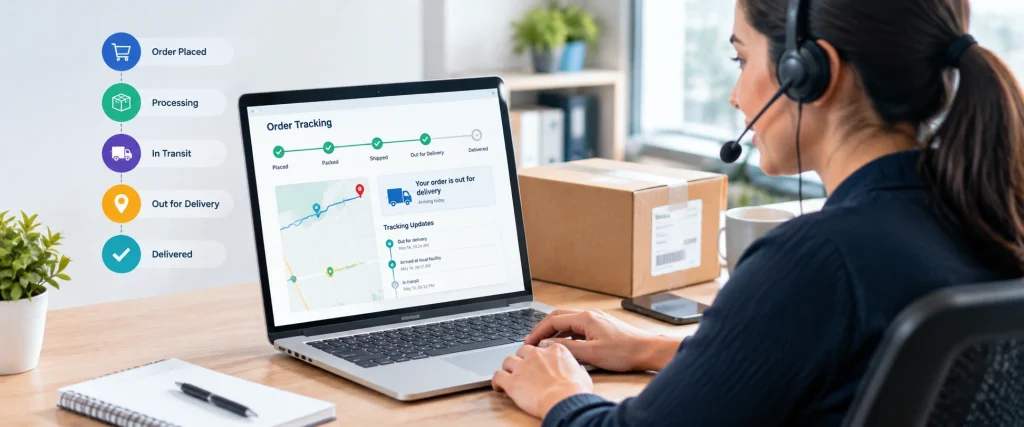
First is post-purchase order support. WISMO queries, delivery exceptions, and order modifications generate the highest inbound contact volumes in ecommerce. A support operation without real-time OMS access cannot handle these accurately. For more on how to reduce this contact type specifically, read our guide on reducing retail WISMO calls.
Second is returns and refund management. Returns in ecommerce are not just a logistics problem. How they are handled shapes whether a customer returns or defects. A support team that processes returns accurately and communicates throughout turns a potentially negative experience into a retention moment. Read more on returns, refunds, and claims outsourcing.
Third is proactive outreach. Waiting for customers to contact you about a delayed shipment costs more than reaching out before they notice. An outsourced partner with proactive notification capabilities deflects contact volume while improving the customer experience.
Fourth is upselling and cross-selling at the service touchpoint. A contact about a delivery question is also a moment where a well-trained agent can surface a relevant product recommendation. Sales and upselling capability within a customer service operation generates measurable revenue lift that pure support models leave entirely on the table.
Fifth is loyalty and subscription management. For brands running loyalty programmes or subscription models, support interactions are where membership value gets reinforced or eroded. An agent who can speak confidently about points balances, tier benefits, and renewal options is doing more than answering a question. Read our guide on loyalty subscription program management outsourcing.
Why Generic BPO Partners Fail Ecommerce Brands
The most common failure in e-commerce customer service outsourcing is choosing a partner based on cost and volume capacity rather than e-commerce-specific operational depth.
A generic BPO can answer contacts at scale. What it cannot do, without the right retail expertise, is make accurate decisions about order exceptions, apply brand-specific returns policies correctly, escalate warranty claims through the right channel, or identify when a frustrated customer is a retention risk rather than just an inquiry.
Ecommerce brands that have been through a failed outsourcing partnership typically describe the same pattern: the partner answered the phones, but the brand’s CSAT declined, return rates stayed high, and no commercially meaningful data came back from the operation. The partner treated the contract as a call volume agreement rather than a CX partnership.
A specialist ecommerce outsourcing partner structures the relationship differently. They report on outcomes, retention rate, repeat purchase rate, CSAT by contact type, and revenue influenced by support interactions.

Building the Right Ecommerce Customer Service Strategy
An effective e-commerce customer service strategy starts with a clear answer to one question: what do you want your support operation to do beyond resolving contacts?
For most brands, the answer involves some combination of reducing return rates through better post-purchase support, increasing repeat purchase rates through proactive outreach, and improving loyalty programme engagement through competent membership support.
After defining the outcomes, the partner selection process becomes straightforward. The right partner is the one who can measure progress against those outcomes, has the ecommerce operational depth to actually move them, and runs the technology integrations that make accurate, real-time customer support possible.
For a practical framework on how to evaluate and select a contact center partner, read our guide on choosing the right retail contact center partner.
The Brands That Get This Right Grow Faster
One retail CX outsourcing provider that US ecommerce brands are increasingly partnering with to build outcome-oriented support operations is this specialist retail and ecommerce BPO, with dedicated ecommerce practice teams and pre-built integrations into the major platforms US brands run on.
The brands that treat customer service as a growth function rather than a cost function consistently outperform those that do not. According to Forrester, customer-obsessed organizations achieved 10% or more revenue growth in the last fiscal year at a rate four times higher than CX laggards. In ecommerce, where customer acquisition costs have more than tripled in the last decade, retaining more of the customers you already have is the highest-ROI strategy available.
We go deeper on how high-touch recovery tactics help DTC brands claw back lost cart revenue in Reclaiming the $18 Billion DTC Revenue Leak with High-Touch Recovery.
Talk to ServeRetail about building an ecommerce customer service strategy that connects support directly to commercial outcomes. For more context, read our analysis of why retail customer support has become a growth strategy and our guide on omnichannel retail customer support.