


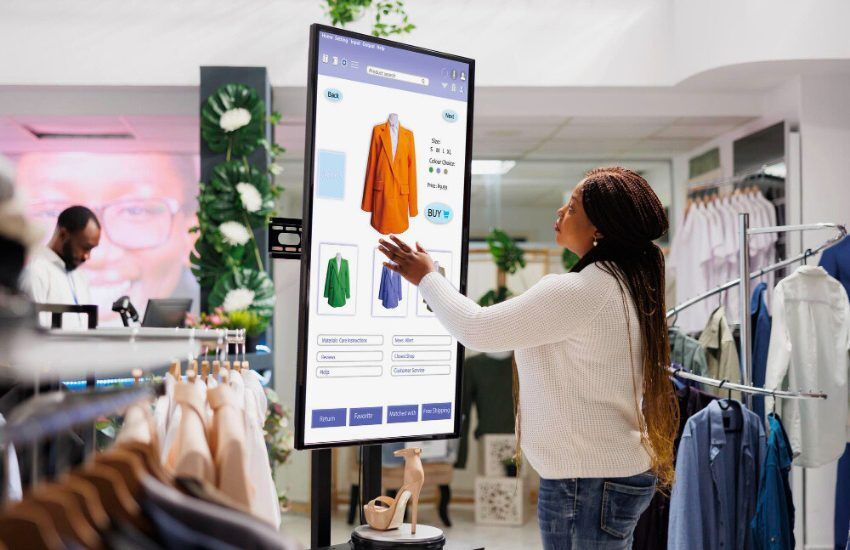

Remember when headlines throughout the late 2010s and early 2020s often predicted that AI and automation would eliminate millions of jobs?
Fast-forward to today, and retail remains deeply dependent on human judgment, product knowledge, relationship-building, and customer service—even as automation has taken over an increasing number of routine tasks. AI has certainly changed retail. It can automate tracking updates, categorize tickets, flag potential fraud patterns, summarize conversations, and draft routine responses. But in many customer-service environments, automation has also shifted human work toward more complex interactions rather than simply eliminating the need for people.
AI hasn’t simply replaced retail workers. In many cases, it has replaced or reduced the need for certain tasks, while changing what human workers spend their time doing.
Retailers operating across markets such as the U.S., Canada, Europe, and China increasingly have to balance automation with human expertise. The resulting model is often a hybrid CX team: people handling judgment-intensive interactions while AI supports routine work, triage, information retrieval, and workflow management.
The impact varies by retailer and workflow, but the underlying logic is straightforward: automation can absorb repetitive interactions while human agents focus on exceptions, complex questions, and emotionally sensitive situations. The effectiveness of that model depends heavily on how well the technology, escalation rules, training, and human teams are designed.
The potential CX benefit is equally important: when routine work is automated effectively, human agents can spend more time on the interactions where empathy, judgment, and product expertise matter most.
Let’s break down how we got here, and why hybrid CX teams are now the backbone of modern retail success.
Why Human Expertise Still Matters in Retail CX
Retail CX is unusually complex because customers often need more than transactional support. Questions can involve product knowledge, personal preferences, technical compatibility, policies, delivery constraints, and emotional context—all within the same conversation.
It involves:
- Size/fit recommendations (apparel)
- Shade matching (beauty)
- Device compatibility (electronics)
- Installation guidance (home improvement)
- Marketplace compliance support (Amazon, Walmart, and TikTok Shop)
- Returns and refund processing
- Social shopping DMs
- Global shipping complexity
AI can increasingly support these activities, but human expertise remains important when a situation requires contextual judgment, nuanced product knowledge, empathy, or accountability for the final decision.
Not every customer interaction needs the same level of automation
Automate
Order status
Return labels
Basic FAQs
Routine updates
AI + Human
Product discovery
Compatibility
Policy questions
Recommendations

Human-led
Sensitive complaints
Ambiguous cases
High-value customers
Escalations
Here’s why AI alone fell short:
1. Retail questions are precise and often unpredictable
A chatbot can handle:
- “Where is my order?”
- “Send return label.”
- “Cancel order.”
But complex questions can require considerably more context, such as:
- “Is shade 4N too warm for medium-toned olive skin?”
- “Will this drill bit work with Canadian electrical standards?”
- “My TikTok influencer recommended size M, but I’m between sizes.”
These require interpretation, not automation.
2. Retailers need conversation, not canned responses
AI excels at speed and consistency, while human agents remain valuable when customers need reassurance, nuanced explanations, or judgment. The strongest CX models increasingly use both rather than treating them as competing approaches.
Research from Salesforce has also highlighted the role of AI in reducing routine service work and allowing agents to focus on more complex customer interactions.
3. Sensitive issues demand empathy, not efficiency
Try using a chatbot for:
- Damaged delivery complaints
- Wrong-size frustrations
- First-time tech buyers
- Cross-border shipping problems
These situations often require more than a fast automated response; they require context, empathy, and a clear path to human escalation.
4. Retail workflows aren’t linear
A beauty buyer might ask about:
AI can handle portions of the early interaction, while human specialists can step in when the conversation becomes more nuanced or commercially important.
So, What did AI Actually Replace?
AI has increasingly automated parts of retail work that are repetitive, rules-based, or highly predictable:
- Repetitive ticket tagging
- Checking order status
- Answering duplicate FAQs
- Logging product-level complaints
- Triaging customer inquiries
- Detecting fraud patterns
- Flagging repeat issues
- Monitoring marketplace rule changes
That freed human agents to focus on:
- Pre-purchase guidance
- Cross-selling
- Solving complex issues
- Building customer trust
- Recovering failing customer journeys
- Supporting high-value marketplace accounts
In the right workflows, automation can increase the amount of customer work a team can handle without requiring every interaction to be fully automated.
More importantly, it has contributed to the evolution of existing roles-and the emergence of new responsibilities around AI, digital commerce, data, and customer experience.
The Retail Roles Emerging Around AI
Several roles and responsibilities are becoming increasingly important as retailers integrate AI into customer-facing operations.
The human work around AI is becoming more specialized
01
CX Product Specialists
Fit, shade, compatibility and product guidance.
02
Social Commerce Managers
Customer conversations across social shopping channels.
03
AI Quality Specialists
Reviewing AI responses and improving workflows.
04
Marketplace Specialists
Policy, seller performance and operational support.
05
CX Data Interpreters
Turning customer signals into operational insight.
06
Post-Purchase CX Managers
Managing the customer journey after checkout.
1. CX Product Specialists (Apparel, Beauty, Electronics)
These are experts who guide buyers:
- Choosing the right size
- Matching foundation shades
- Determining tech compatibility
- Recommending bundles
AI can surface relevant product information and patterns; human specialists can apply that information to the customer’s specific situation.
2. Social Commerce Response Managers
Shoppers now send pre-sale questions through:
- Instagram DMs
- TikTok Shop chat
- Facebook Marketplace messages
- Pinterest Product Pins
- Xiaohongshu (China)
- WhatsApp Business
Retailers need humans who speak in brand voice, analyze buyer intent, and turn conversations into conversions.
3. AI Supervision Agents (AI + Human Hybrid Role)
These professionals:
- Correct AI mistakes
- Refine response quality
- Train AI models with retail-specific knowledge
- Ensure compliance
- Prevent hallucinations
As generative AI has become more common in customer-facing workflows, responsibilities such as AI response review, knowledge management, quality assurance, and AI governance have become increasingly important.
4. Marketplace Compliance Specialists
Major marketplaces regularly update seller policies, performance requirements, and operational rules.
Hybrid teams:
- Monitor seller metrics
- Prevent penalties
- Manage returns
- Guide buyers
- Validate tracking numbers
- Coordinate retail order processing
AI flags issues. Humans fix them.
5. CX Data Interpreters
AI produces vast data: sentiment scores, ticket categories, and issue trends.
But interpreting that data and connecting it to real retail behavior often requires human context and business judgment.
6. Post-Purchase Customer Experience Managers
Modern retail expects:
- Faster refunds
- Smarter bundling
- Proactive delivery updates
- Micro-personalization
Hybrid teams manage this proactively, using AI for alerts and humans for resolution.
Why Retailers Are Exploring Hybrid CX Teams
Fully automated and fully manual approaches each have limitations. Automation can struggle with ambiguity and emotionally sensitive interactions, while human-only operations can face challenges around scale, repetitive workloads, and consistency. Hybrid models attempt to address both sets of challenges.
But brands that adopted hybrid models saw the best results:
AI accelerates the journey. Humans step in where context matters.
Customer
Starts conversation
AI Triage
Intent + priority
Human Expert
Judgment + resolution
Learning
QA + improvement
1. Faster response times (AI triage + human expertise)
AI-assisted triage can reduce the time required to identify, categorize, and route customer requests, allowing human agents to spend more time on complex cases.
2. Lower return rates
Especially in apparel, beauty, and electronics.
AI can surface product information, compatibility signals, and customer preferences, while human specialists can help resolve uncertainty before the purchase. In categories where fit or compatibility matters, better guidance may help reduce avoidable returns.
ServeRetail clients see a 20–30% reduction in returns within 90 days.
3. Higher conversion rates
Faster responses and useful pre-purchase guidance can remove friction from the buying journey.
Especially in:
- Social commerce and live shopping
- TikTok Shop live selling
- European apparel and fashion
- Cross-border electronics
4. Better marketplace compliance
AI can flag potential compliance issues; human specialists can investigate and resolve them.
Retailers avoid:
- Amazon late shipment flags
- Walmart cancellation penalties
- TikTok Shop performance hits
5. Global coverage without burnout
Hybrid teams handle:
- U.S. daytime
- EU evening
- China morning
- Canada weekend spikes
This model can also help retailers extend coverage across time zones while keeping human escalation available when needed.
How a Hybrid Retail CX Model Works in Practice
What should AI handle?
Automate or assist
Order status, FAQs, routing, routine updates and structured workflows.
Assess context
Determine whether ambiguity, emotion, risk or product expertise is involved.
Human-led
Use AI as an assistant while the human specialist owns the interaction.
Hybrid opportunity
Let AI accelerate the workflow while keeping human escalation available.
ServeRetail combines:
AI for:
- Ticket routing
- Intent detection
- Return automation
- Fraud flagging
- Rule change alerts
- Conversational drafts
- Sentiment scoring
Human specialists can handle:
- Apparel sizing and fit questions
- Beauty product guidance
- Electronics troubleshooting
- Marketplace operations
- Complex customer support
- Social commerce conversations
- Retail order processing
AI Didn’t Replace Retail Jobs, It Rewrote Them
The retail industry didn’t lose jobs. It gained better jobs.
Today’s retailers need:
- Humans who think
- AI that accelerates
- Teams that collaborate
- Workflows that adapt
- Support that sells
- CX that understands global shoppers
Hybrid CX teams are not the future of retail. They are the present, and ServeRetail is already powering them.
From manual support to adaptive CX operations
A simple framework for understanding how retail CX operations can evolve.
Manual
People manage most customer interactions manually.
Assisted
AI supports agents with information and response drafting.
Hybrid
AI handles defined workflows while people manage exceptions.
Adaptive
AI, people and QA continuously improve the operation.
Ready to build your hybrid retail CX workforce?
This connects to a related piece: ChatGPT Is the New Mall: How Agentic Commerce Will Outsell E-Commerce by 2027.
ServeRetail can help you scale globally with intelligent automation + exceptional human talent. Contact us now!


