





Global Autonomous Retail Technology Provider Maintained 99.65% SLA Across Event-Driven Retail Operations
99.65%
SLA Adherence
100+
Live Events Supported Annually
40% Faster
Average Onboarding Time
Powering autonomous retail operations with real-time data annotation, event-ready staffing, and technical support built around rapidly changing demand.
The Client
A global autonomous retail technology provider enables frictionless shopping across grocery stores, retail locations, stadiums, arenas, and other high-traffic environments. Its AI and computer vision technology supports autonomous purchasing experiences, creating a specialized operational need for accurate data annotation, real-time support, and responsive workforce capacity across live retail environments.
The Challenge: When Autonomous Retail Meets Unpredictable Real-World Demand
Autonomous shopping environments create a distinctive operating challenge. Technology may automate the transaction, but the data and support infrastructure behind that experience must react to customer behavior in real time. For this provider, rapid international expansion made that requirement increasingly complex.
Live Events Created Sharp Demand Swings
Stadium and arena events required data annotation coverage during concentrated four-to-five-hour windows. Customer activity could change dramatically from one event to another. Staffing, therefore, had to respond quickly without leaving unnecessary capacity between events.
Data Accuracy Could Not Be Sacrificed for Speed
Real-time annotation teams were responsible for interpreting customer behavior and purchasing activity. Fast turnaround mattered, but accuracy remained equally important because the work contributed directly to the performance of autonomous shopping environments.
Legacy Operations Required Continuous Coverage
Alongside new deployments, existing systems still required 24/7 First Line of Support. The team needed enough technical capability to resolve more issues independently while avoiding unnecessary escalation to TechOps.
Geographic Expansion Complicated Workforce Planning
Support requirements extended across Europe and the United States, while delivery resources operated from multiple locations in India and Morocco. Recruiting, training, scheduling, and quality practices needed to work consistently across this distributed model.
Bottom Line
Autonomous retail created a workforce problem unlike conventional customer service. Demand could rise within hours, technical issues required informed intervention, and annotation work had to remain accurate at speed. The provider needed a partner that could combine real-time staffing, disciplined data operations, technical support, and cross-geography workforce planning within one adaptable delivery framework.
The Solution: Human-in-the-Loop Retail Operations Engineered Around Real-Time Demand
ServeRetail built a distributed operating model around the way autonomous retail actually functions. Instead of treating data annotation and support as static back-office queues, the teams were organized around live deployments, event schedules, technical requirements, and changing transaction volumes.
Event-Ready Retail Data Annotation
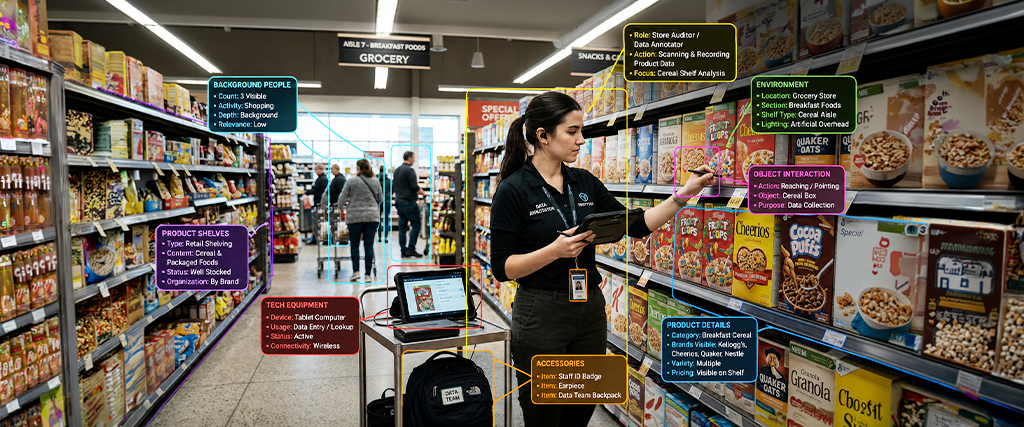
Dedicated teams supported real-time annotation of shopper behavior and purchasing activity during live retail and venue operations. Staffing plans accounted for short, high-intensity event windows so capacity could be aligned more closely with actual demand.
This approach gave the client access to trained resources when activity surged without requiring the same staffing profile during lower-volume periods.
Multisite Workforce Planning
Workforce management was coordinated across delivery operations in India and Morocco. A predominantly full-time model was complemented by site-specific flexibility to address immediate coverage requirements.
Recruiting, onboarding, training, quality management, and performance practices were centralized wherever possible. As a result, geographically distributed teams could operate against shared standards rather than functioning as isolated delivery groups.
24/7 First Line of Support
ServeRetail expanded beyond annotation into First Line of Support for legacy environments. The support team developed greater ownership of technical issues and progressively handled more cases without depending on TechOps.
That development mattered operationally. It reduced unnecessary escalations while giving the client’s specialist technical teams more room to concentrate on higher-complexity work.
Faster, Centralized Onboarding
Processes that had previously been distributed were consolidated and standardized. This reduced average onboarding time by 40%, allowing new resources to reach operational readiness faster as deployments and support requirements evolved.
Faster onboarding also improved the client’s ability to respond to new launches without rebuilding processes for each location or program.
Direct Collaboration with Engineering and AI Teams
The engagement extended beyond task execution. Operational teams shared observations, analytics, and process feedback with the client’s engineering and AI stakeholders.
That consultative relationship allowed insights from live operations to inform service and product development. Feedback from the program ultimately contributed to two product releases, demonstrating how frontline operational knowledge could influence the underlying autonomous retail technology.
The Results: From a Single European Workstream to a Broader Autonomous Retail Support Model
The relationship developed from a focused data annotation requirement into a wider operational partnership. Over time, ServeRetail supported additional service lines, new geographies, live-event deployments, and technical support responsibilities while maintaining demanding performance requirements.
- 99.65% SLA Adherence During High-Demand Operations: The program achieved 99.65% SLA adherence during the 2024 measurement period. Performance remained strong even as the operating environment expanded into high-demand pilots and event-driven deployments. For an operation exposed to sudden fluctuations in shopper activity, the result demonstrated the effectiveness of event planning, workforce coordination, and standardized delivery practices.
- More Than 100 Live Events Supported Each Year: Real-time teams supported 100+ live events annually across three geographies. Event coverage included the concentrated demand patterns associated with stadiums, arenas, games, concerts, and other large-format environments. Rather than applying conventional static staffing, resources could be aligned with event schedules and anticipated customer activity.
- Three Lines of Business Established Within 24 Months: The partnership developed from its original European operation into three lines of business within 24 months. Expansion included retail data annotation and First Line of Support as the provider’s geographic footprint and operational requirements grew. This progression turned the relationship into a broader support ecosystem rather than a single-function outsourcing program.
- $0.05 Cost per Transaction Sustained for More Than Three Years: Through labor-market diversification and operating-model refinement, the program achieved and maintained a $0.05 cost per transaction for more than three years. The result demonstrates that specialized human-in-the-loop retail operations can be scaled economically while continuing to meet stringent service expectations.
- Average Onboarding Time Reduced by 40%: Centralizing previously fragmented onboarding activities reduced average onboarding time by 40%. Faster readiness became particularly valuable as new locations, events, and operational requirements created recurring demand for trained resources.
- First-Time Fix Performance Improved by 20%: Following increased ownership of the First Line of Support service desk, First-Time Fix rates improved by 20% compared with the prior year. At the same time, fewer issues required escalation to TechOps. The support team became better equipped to diagnose and resolve complex problems independently, reducing pressure on specialist technical resources.
- Operational Feedback Contributed to Two Product Releases: ServeRetail’s role evolved into active collaboration with the client’s engineering and AI teams. Insights from live operations, data analytics, and process reviews contributed feedback used in two product releases. This created a valuable feedback loop between real-world retail activity and technology development.
Key Insights
Autonomous Retail Still Depends on Human Precision
Computer vision and AI can transform the checkout experience, but human-in-the-loop operations remain important when technology must interpret complex real-world shopper behavior. Accurate annotation helps connect automated systems with what is actually happening inside stores and venues.
Event-Based Retail Requires a Different Workforce Model
A stadium at capacity does not behave like a conventional store on an average weekday. Workforce plans must account for sharp arrival patterns, limited operating windows, and rapidly changing transaction volumes rather than relying solely on traditional monthly forecasts.
Technical Support Becomes More Valuable as Ownership Deepens
First Line of Support creates greater value when teams can solve problems instead of simply routing them elsewhere. Building technical expertise improves resolution while reducing avoidable pressure on engineering and specialist support functions.
Operational Data Can Improve the Product Itself
Frontline teams see how technology performs under real conditions. When those observations flow back to engineering and AI teams, outsourced operations can contribute not only to service delivery but also to product improvement.
Ready to Scale Your Retail Data Operations?
Build a retail data annotation and support model designed for AI-powered commerce, live deployments, and rapidly changing customer demand.
INDUSTRY
Ecommerce
REGION
United States | Europe | India | Morocco