The acquisition signals the end of standalone fresh delivery startups — and reveals brutal truths about getting vegetables to your door in under 30 minutes
When Meituan announced it would acquire Dingdong‘s China operations for $717 million in cash this February 2026, the collective reaction from China’s tech industry was two words: finally, and about time. The deal absorbs more than 7 million monthly transacting users and over 1,000 front-end warehouses, marking one of the most significant consolidations in Chinese e-commerce in years (Caixin Global).
But beyond the headline numbers lies a story about why delivering fresh groceries profitably remains one of retail’s most punishing challenges — and what it means when even successful players choose to sell rather than fight alone.
The Scale of China’s Grocery Battleground
China’s online grocery market was valued at approximately $184 billion in 2024 and is projected to reach nearly $2 trillion by 2034 (Expert Market Research). The quick commerce segment alone — focused on ultra-fast delivery — stands at $91.75 billion in 2025 (Mordor Intelligence).
These numbers explain why tech giants are willing to burn billions fighting for market share. They also explain why most standalone players have either collapsed or sought buyers.
“More merger and acquisition deals can be expected as gargantuan delivery firms look to enlarge their business scale and enhance operating efficiency in a cutthroat market,” observed Ding Haifeng, a consultant at Shanghai-based financial advisory firm Integrity, speaking to the South China Morning Post. “Most small players, facing financial difficulties, are willing to be assimilated by big rivals as competition escalates.”
Dingdong’s Remarkable Survival Story
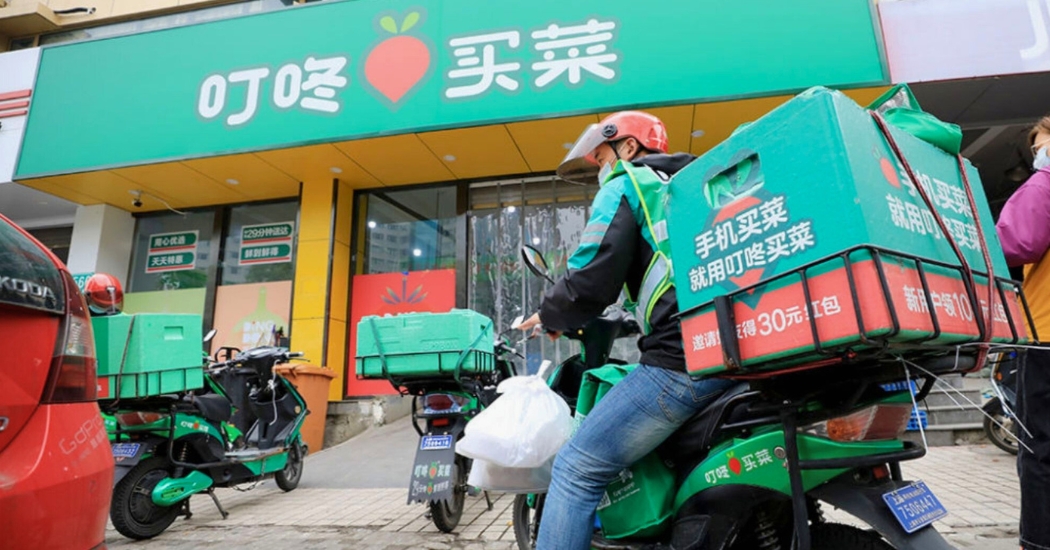
Founded in 2017 in Shanghai by serial entrepreneur Liang Changlin, Dingdong pioneered distributed “dark warehouses” positioned within residential neighborhoods to enable 29-minute grocery delivery (PYMNTS). The model attracted SoftBank, General Atlantic, and Sequoia Capital, culminating in a 2021 NYSE IPO.
The years following were brutal. Fresh produce is heavy, perishable, and low margin. Customers expect perfection while paying commodity prices. Any ecommerce call center operator handling fresh grocery complaints knows the pain: a wilted lettuce leaf or bruised apple destroys trust instantly. The logistics of maintaining cold-chain integrity while managing thousands of daily orders requires capital investment that generates returns measured in pennies.
While competitors like MissFresh aggressively expanded into lower-tier cities and eventually collapsed, Dingdong made a different choice: it retreated to its profitable strongholds. By Q3 2025, this discipline paid off spectacularly — the company reported record revenue of 6.66 billion yuan, GAAP net profit of 133 million yuan, and 12 consecutive quarters of non-GAAP profitability (36Kr).
An investor in Dingdong offered 36Kr a candid assessment: “When big tech companies keep pouring money into the space, there aren’t many good countermeasures. Back when the frontend warehouse model was booming, players flooded in. To still be sitting at the table today is already rare.”
The same investor added something revealing about founder Liang: “He is really a person who spends 80% of his time out in the fields. He could have stayed in Shanghai and lived comfortably, but instead chose to live like a farmer.”
Why Meituan Paid a Premium
At market close on February 5, Dingdong’s market cap stood at approximately $694 million, indicating that Meituan paid above-market value for the China operations alone (DealStreet Asia). The rationale becomes clear when you understand Meituan’s strategic gaps.
In 2021, CEO Wang Xing announced that Meituan’s strategy would shift from “Food + Platform” to “Retail + Technology” (TechNode). While Meituan’s Xiaoxiang Supermarket brand has grown to nearly 1,000 stores, Shanghai has historically been a weak region, precisely where Dingdong dominates. In Shanghai, Dingdong’s average daily order volume per warehouse is approaching 1,700, and regional GMV is growing 24.5% year over year.
For any retail call center tracking fulfillment metrics, these numbers represent operational excellence that takes years to develop. Meituan is essentially buying the capability it couldn’t build organically fast enough.
“For Dingdong, selling at this time is a rational choice to ‘get out at a high point’ after proving its own value,” the 36Kr analysis noted. “For Meituan, it is to acquire a core asset that has passed the most dangerous loss-making period.”
The Human Cost and Regulatory Path
The deal requires approval from China’s State Administration for Market Regulation, which has blocked high-profile acquisitions since 2021. However, the regulatory environment appears more accommodating in 2026, and the deal’s modest size relative to Meituan’s $71 billion market cap may reduce complications (Caproasia).

For Dingdong’s employees, uncertainty looms. “The news has spread within the company, which has a great impact on employees’ morale,” one employee told 36Kr. “Many colleagues think there will soon be staff optimization.”
Founder Liang appears to have anticipated this moment; sources indicate he’s already leading part of his team toward a “second entrepreneurship,” building B2B overseas operations.
What This Means for Retail’s Future
The Meituan-Dingdong deal confirms what industry observers suspected: the era of standalone fresh grocery delivery startups has ended. Survivors are either profitable niche players or acquisition targets for platforms that can amortize enormous, fixed costs across multiple revenue streams.
For consumers, consolidation brings mixed implications. Combined operations could deliver better selection and faster service through supply chain efficiencies. But reduced competition may eventually mean less innovation and higher prices.
Meituan’s competitors — Alibaba’s Freshippo, JD.com’s 7Fresh, and Pinduoduo’s community-buying operations – will likely accelerate their own investments in response. The grocery wars aren’t ending; they’re simply entering a phase where only giants can afford to play.
Whether Meituan’s $717 million bet pays off will determine not just one company’s fortunes, but potentially how 1.4 billion people buy their vegetables for decades to come.