
Every online retailer eventually reaches the same inflection point. Sales are climbing. The product is solid. The website converts. And then, usually at 11:47 PM on the Friday before a long weekend, the customer service inbox becomes a haunted house. Orders are delayed. Return requests pile up. A shopper who waited five business days for a reply quietly leaves a two-star review and never comes back. This is the moment most growing ecommerce brands realize they have been treating customer service as an afterthought. In 2025, that is a very expensive habit.
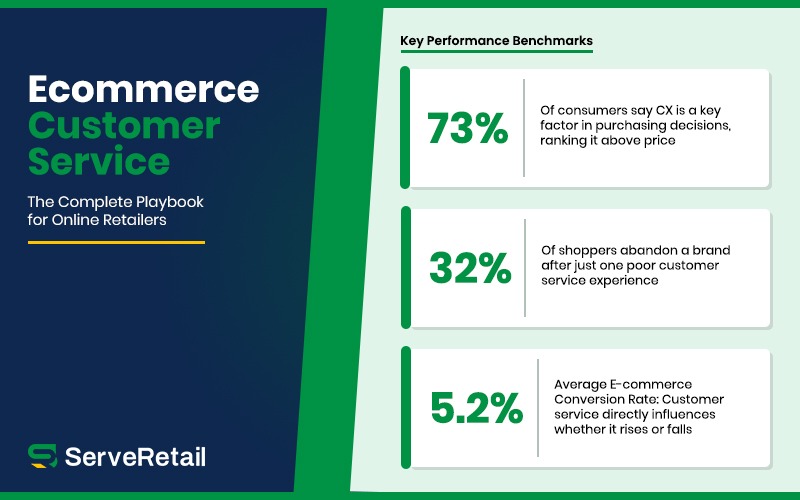
Ecommerce customer service is no longer a back-office function. It is a direct driver of revenue, retention, and brand reputation, and the data makes this impossible to ignore. According to PwC, 73% of consumers say that customer experience is a key factor in their purchasing decisions, ranking it above price and product quality. Meanwhile, research from Bain & Company shows that increasing customer retention by just 5 percent can boost profits by 25 to 95 percent [Bain & Company, 2000]. The numbers are not subtle. Neither is the opportunity.
This guide exists for a specific kind of reader: the ecommerce operator, CX director, or founder of a growing online retail brand who understands that good customer service matters, but who has not yet figured out how to build it in a way that actually scales. We are not here to sell you software. We are here to tell you what works, where the gaps are, and how to fix them without burning through your margins.
What Ecommerce Customer Service Actually Means
The definition sounds simple enough: ecommerce customer service encompasses every interaction between your brand and a customer before, during, and after a transaction. In practice, however, it is far messier than any textbook description suggests. A customer might message your Instagram DMs about a shipping delay, follow up via live chat ten minutes later, send an email the next morning, and then post publicly about the experience on Reddit, all for the same order. Managing this without losing your mind (or your CSAT score) is the central challenge of modern online retail.
What makes ecommerce customer service distinctly different from in-store retail support is the complete absence of the physical buffer. In a brick-and-mortar store, a customer who cannot find a product can ask a floor associate. There is body language, ambient context, and the psychological reassurance of physical presence. Online, when something goes wrong, the customer is alone with their frustration and a browser tab. The clock starts immediately. According to Salesforce research, 83% of customers expect to interact with a real person when contacting a company. Not in an hour. Not tomorrow. Now.
The nature of the inquiries themselves has also shifted. The majority of customer interactions today involve order changes, shipping updates, returns, refunds, loyalty program management, and account issues, not pre-purchase product questions. These are emotionally charged, time-sensitive contacts. Getting them right builds loyalty. Getting them wrong drives churn.
Why Most Ecommerce Brands Are Getting This Wrong
Here is an uncomfortable truth: the problem is rarely the team. The agents are often skilled, motivated, and genuinely trying to help. The problem is structural. Growing ecommerce brands tend to inherit customer service setups designed for a much smaller operation, a shared inbox, a part-time agent, a Slack channel for urgent escalations, and then try to scale them by adding more people. This creates a kind of organized chaos that feels functional until volume spikes, at which point it collapses spectacularly.
“Every year, Black Friday arrives like an unexpected house-guest. You know it’s coming. You are still not ready for it.”
Peak season is the clearest stress test. Black Friday, Cyber Monday, the holiday window, and post-Christmas returns can create contact volume that exceeds typical daily demand by 3 to 5 times. Brands that rely on in-house teams scramble to hire temporary agents, overpay for rushed onboarding, and often end up with underprepared staff handling their most critical customer interactions of the year. It is a costly and deeply avoidable problem.
The second structural failure is channel fragmentation. Today’s ecommerce customers expect support across voice, live chat, email, SMS, social media, and marketplace messaging, with continuity between them. A customer who explained their issue in a chat window should not have to repeat the entire story when they call in. Yet fragmented systems create exactly that experience, which is why, according to Qualtrics XM Institute, 56% of consumers have to repeat their information to multiple agents. Every repetition is a small erosion of trust.
The third failure is the WISMO problem, Where Is My Order, which has become one of the highest-volume inquiry types across virtually every ecommerce vertical. Shipping delays, carrier exceptions, tracking inconsistencies, and last-mile confusion generate enormous inbound volume that could, in large part, be prevented through better proactive communication, automated tracking updates, and trained agents who can de-escalate delivery anxiety without simply offering a refund. The brands that have built dedicated WISMO management frameworks are consistently ahead on both customer satisfaction and operational efficiency.
The Seven Challenges Every Ecommerce Brand Must Solve
1. Returns, Refunds, and the Expectation Economy
Online shopping carries an inherent limitation: customers cannot touch, try, or fully evaluate a product before purchasing. This results in structurally higher return rates than in physical retail. The National Retail Federation reports that online return rates average around 17.6%, compared to 10.02% across all retail [NRF, 2023]. Poorly managing returns is not just a customer service failure; it is a logistics and financial failure as well. Brands that invest in frictionless, clearly communicated return processes recover a higher percentage of those customers for future purchases.
2. Scaling Through Peak Seasons Without Sacrificing Quality
The math is straightforward and brutal: you cannot hire, onboard, and train enough full-time agents to handle a 400% volume spike for six weeks and then sustain that headcount for the other 46 weeks of the year. The brands that handle peak season well have built scalable operational models, typically through a combination of specialized outsourcing, proactive self-service tools, and pre-built escalation paths. They plan for Black Friday in July. It is a mindset shift as much as an operational one.
3. Multilingual Support as a Growth Unlock
As ecommerce brands expand into new markets, whether across the U.S. Spanish-speaking population, into Canada’s French-speaking regions, or into international territories, language becomes a customer service variable, not just a marketing one. A shopper who contacts support in their native language and receives a generic English-only response is significantly less likely to convert again. Multilingual support capability covers this across voice, chat, email, and social channels, which matters because language fluency requirements vary by contact type. An agent who can handle a chat in Spanish needs different skills than one managing a nuanced voice escalation.
4. Marketplace Complexity and Seller Support
The growth of marketplace commerce, Amazon, Walmart.com, eBay, and dozens of regional platforms, has added a layer of complexity that many brands underestimate. Marketplace channels have their own SLA requirements, seller performance metrics, messaging protocols, and dispute resolution processes. Failing to meet them results in seller account penalties, buy box suppression, and, in serious cases, delisting. As analysis of the world’s largest ecommerce marketplaces illustrates, the CX demands on marketplace sellers are structurally different from those in D2C support and require staffing and management accordingly.
5. Cross-Border Commerce and Regulatory Complexity
Cross-border ecommerce introduces customer service challenges that go well beyond translation. Tax and duty inquiries, customs delays, differing return regulations, and currency-related confusion all generate inbound contacts that require agents with specific regional knowledge. European markets, in particular, have distinct regulatory frameworks that shape what customers expect and what retailers are legally required to provide. How cross-border commerce is reshaping EU retail support models is a useful lens for understanding the operational implications for brands expanding internationally.

6. Balancing Automation with Human Judgment
AI-powered chatbots, automated email routing, and intelligent self-service tools have become standard infrastructure for ecommerce customer service, and for good reason. Automation handles repetitive, high-volume inquiries efficiently, freeing human agents to focus on complex, emotionally sensitive interactions. The failure mode is over-automation: brands that push too many contacts through AI workflows without adequate human escalation paths create frustration at precisely the moments when customer goodwill is most fragile. The right balance is not a fixed ratio. It depends on ticket type, customer segment, and brand positioning.
7. Building a Contact Center That Doesn’t Break the Budget
The economics of in-house customer service at scale are genuinely difficult. Hiring, training, benefits, real estate, management overhead, and attrition costs add up fast. For many mid-market ecommerce brands, those generating between $10M and $200M in annual revenue, the decision to outsource customer service is not a question of capability. The question is whether the cost structure makes sense. The quiet migration of U.S. retailers toward nearshore and offshore support models is driven precisely by this calculus, as ServeRetail’s analysis of the LATAM support shift documents in detail.
Ecommerce Customer Service Best Practices That Actually Move the Needle
Build for the Channel Your Customer Is Already Using
The temptation is to launch every channel simultaneously and figure out staffing later. This is how brands end up with a live chat widget that nobody monitors and a social media inbox that responds in four days. A more effective approach is to audit where your customers are contacting you, prioritize those channels for quality coverage first, and expand deliberately. According to Salesforce, 76% of customers prefer different channels depending on the context of their issue. This is not a reason to be everywhere simultaneously. It is a reason to understand your specific customer base and meet them where they concentrate.
Make Self-Service Work Before You Need It To
A well-built knowledge base, an accurate FAQ section, and a functional order tracking integration can deflect between 20 and 40 percent of inbound contacts without any agent involvement [Zendesk CX Trends Report, 2023]. But self-service only works if it is accurate, up to date, and easy to navigate. Outdated return policy pages, broken tracking integrations, and knowledge bases that answer questions nobody is asking are worse than no self-service at all, because they waste the customer’s time before they end up calling anyway, now angrier than when they started.
Use Data to Prevent Contacts, Not Just Resolve Them
The most efficient ecommerce customer service operation is one that reduces the need for customer service in the first place. This means systematically analyzing contact drivers: What are the top five reasons customers are reaching out this week? Are there product pages generating disproportionate confusion? Are shipping carrier issues in a specific region driving WISMO spikes? Using contact data as an operational diagnostic tool, rather than just a CSAT input, is the difference between reactive and proactive support.
Think About First-Contact Resolution as a Revenue Metric
First-contact resolution (FCR) is typically framed as an efficiency metric. It is also a revenue metric. Research from ICMI shows that a 1% improvement in FCR correlates with a 1% improvement in customer satisfaction. Satisfied customers buy more, return more often, and refer others. Brands that invest in giving agents the tools, authority, and information to resolve issues on the first contact, rather than escalating or deferring, see compounding returns on that investment over time.
When Outsourcing Ecommerce Customer Service Makes Strategic Sense
There is a particular point in the growth curve of an ecommerce brand where the conversation about outsourcing customer service shifts from “we could never do that” to “we have to figure this out.” It typically arises when the cost and complexity of managing in-house support start to meaningfully divert resources from product, marketing, or operational priorities closer to the brand’s core.
Outsourcing is not abdication. Done well, it is a deliberate extension of your customer experience capability to a partner with deeper infrastructure, specialized retail expertise, and the operational elasticity to scale up for Black Friday and scale back down in February without the headcount turbulence that would accompany an in-house model. The key is choosing a partner that understands retail, not just general BPO, and has the vertical experience to handle the complexity of ecommerce.
The geographic dimension of this decision is also worth understanding clearly. Nearshore models, particularly in Latin America, offer time-zone alignment, bilingual capability, and cultural proximity for U.S. brands. Philippines-based call centers have a well-documented history of high English proficiency and ecommerce-specific training pipelines, as Australian ecommerce brands have increasingly recognized. The right model depends on your customer base, channel mix, volume patterns, and brand tone—and often involves a combination of locations rather than a single-site decision.
What the best ecommerce BPO partnerships share is not geography. It is a commitment to retail-specific expertise, measurable SLA accountability, scalable staffing models, and the ability to operate as a genuine extension of the brand, not a generic answering service with a different area code. The distinction matters more than it sounds. A retail-specialized contact center brings category knowledge, returns management experience, marketplace fluency, and seasonal staffing discipline that a generalist BPO simply cannot replicate, regardless of how competitive the pricing looks on a spreadsheet.
What to Look for in an Ecommerce Customer Service Partner
Choosing the wrong partner is more expensive than building in-house, so the selection criteria deserve more rigour than a three-slide vendor comparison. There are several capabilities that consistently separate high-performing retail BPO partners from adequate ones.
- Retail vertical depth is non-negotiable. A partner who serves financial services, healthcare, and ecommerce simultaneously does not have the operational muscle memory that a retail-specialized operation develops over years of managing returns spikes, inventory escalations, marketplace SLA pressure, and the emotional register of a customer whose holiday gift did not arrive on time. The sector specificity matters in agent training, in quality frameworks, in the language of internal escalation protocols, everywhere.
- Omnichannel operational maturity is the second filter. The ability to staff voice, chat, email, social, and marketplace channels is table stakes. The differentiator is whether the partner can deliver a unified customer experience across those channels, where context travels with the customer, agents have full interaction history, and channel-switching does not create service gaps. This is an infrastructure and process capability, not just a technology one.
- Multilingual coverage at quality is a third dimension that matters more as brands scale. Being able to field contacts in Spanish, French, Portuguese, or Mandarin is not the same as fielding them well. The distinction is between translation-level language skills and native-level cultural fluency, and customers know the difference almost immediately. Brands expanding into multicultural markets or international territories need partners who can staff those language lanes with agents who understand the cultural context of the interaction, not just the words.
- Finally, and this is the one that gets underweighted in almost every vendor evaluation, ask about peak-season readiness. Specifically: how does your partner ramp from baseline to peak-season volume, what lead time is required, which training standard applies to ramped agents, and what happens to quality during the ramp? The answers to those questions tell you more about operational maturity than any case study or pricing deck.
Frequently Asked Questions
What Is the Difference Between Ecommerce Customer Service and Traditional Retail Support?
Traditional retail support benefits from physical presence, agents can read body language, customers have ambient context, and resolution often happens in real time at the point of sale. Ecommerce customer service operates entirely without these advantages. Every interaction is text, voice, or asynchronous, which places higher demands on communication clarity, response speed, and the ability to project empathy through digital channels. Ecommerce support also contends with higher return rates, greater shipping complexity, marketplace channel requirements, and the expectation of 24/7 availability.
How Much Does Ecommerce Customer Service Outsourcing Cost?
Outsourcing costs vary significantly by geography, channel mix, volume commitments, and service-level requirements. Nearshore models in Latin America typically run between $18 and $28 per hour for fully loaded agent costs. Philippines-based operations often range from $10 to $18 per hour. Domestic U.S. operations can run $28 to $45 or higher. For most mid-market ecommerce brands, the total cost of ownership comparison, accounting for hiring, training, attrition, management overhead, technology, and real estate, consistently favors outsourced models at scale. The savings are real; quality need not be the trade-off.
When Should an Ecommerce Brand Start Thinking About Outsourcing Support?
The inflection point is usually between 500 and 2,000 monthly contacts, when the hidden costs of in-house support become visible. Before that threshold, a small, dedicated team often makes sense. Beyond it, the economics of outsourcing, combined with the operational expertise a specialized partner brings, typically deliver better outcomes at lower total cost. Peak-season volatility accelerates this timeline for brands with strong seasonal patterns.
What Channels Should Ecommerce Customer Service Cover?
The baseline for most ecommerce brands in 2025 is live chat, email, and voice, with social media monitoring (at minimum) and marketplace messaging support for brands selling on Amazon, Walmart, or other platforms. SMS is growing as a support and proactive notification channel. The right channel mix for your brand depends on your customer demographics, your ticket volume distribution, and your brand positioning. A luxury fashion brand and a direct-to-consumer supplement company have very different channel priorities, even if both are technically ecommerce businesses.
The Bottom Line
Ecommerce customer service in 2025 is not about hiring more agents and hoping for the best. It is about building, or partnering to access, an operational infrastructure that matches the actual demands of modern online retail: omnichannel, scalable, multilingual, data-driven, and capable of performing under peak-season pressure without compromising quality or brand experience.
The brands winning on customer experience right now did not get there by treating support as a cost center to be minimized. They got there by recognizing that every interaction is a brand moment, and that brand moments, at scale, determine whether a customer buys again, tells their friends, or quietly disappears to a competitor who was one click away all along.
For ecommerce brands ready to build that infrastructure, whether from scratch or by upgrading an existing model, ServeRetail’s ecommerce contact center services are built specifically for this challenge. The retail specialization, the global delivery network, and the operational discipline to handle Black Friday and a slow Wednesday with equal consistency, that is the standard. It is also the baseline expectation of every customer who clicks ‘Buy Now’ and trusts that someone, somewhere, is ready to help if something goes wrong.